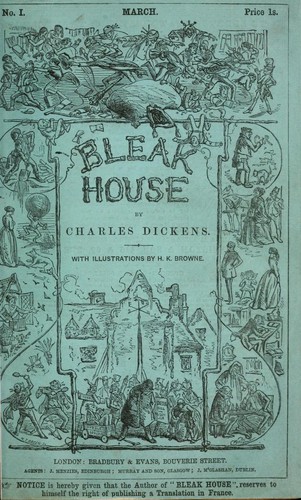
Bleak House
Charles Dickens (1853)
“A fog-bound masterpiece that invented the detective novel, condemned an entire legal system, and proved that institutions can kill as surely as any murderer.”
Bleak House— Historical Context & Author Background
Author: Charles Dickens · Published 1853· Era: Victorian·950 pages
Themes explored: justice, bureaucracy, class, secrets, disease, philanthropy, identity
About Charles Dickens
Charles Dickens (1812-1870) was the most famous writer in the English-speaking world and used that fame as a weapon. As a child, he was sent to work in a blacking factory when his father was imprisoned for debt — an experience of institutional cruelty and class humiliation that powered everything he wrote. By the time he wrote Bleak House (serialized 1852-53), he was at the height of his powers: wealthy, celebrated, and furious. He had seen Chancery firsthand — his own family had been involved in a Chancery case, and he testified before a parliamentary commission on legal reform. Bleak House was not abstract critique; it was testimony.
Life → Text Connections
How Charles Dickens's real experiences shaped specific elements of Bleak House.
Dickens' father was imprisoned for debt when Charles was twelve; the child was sent to Warren's Blacking Factory
The institutional destruction of children — Jo, the brickmaker's children, the neglected Jellyby children, Charley
Dickens' entire career was driven by the childhood experience of being discarded by institutions. Jo is what Dickens might have become.
Dickens' own family was involved in a Chancery case (Dickens v. Dickens, over a disputed inheritance)
The interminable Jarndyce and Jarndyce, with its costs exceeding the estate
The Chancery critique is not literary invention but lived experience. Dickens knew how the system consumed people because it consumed his family.
Dickens was a journalist and editor before becoming a novelist, reporting on Parliament and the courts
The omniscient narrator's forensic, documentary voice — present tense, sweeping, evidence-based
Dickens' journalistic training produced the novel's investigative narration. The omniscient voice is a reporter's voice amplified to panoramic scale.
Dickens ran a charity home for 'fallen women' (Urania Cottage) with Angela Burdett-Coutts
Lady Dedlock's secret — an unmarried mother punished by society for a sexual past
Dickens' work with Urania Cottage gave him direct knowledge of how Victorian morality destroyed women. Lady Dedlock's shame is what he saw every day.
Historical Era
1850s England — industrialization, sanitary crisis, legal reform debates, the Great Exhibition
How the Era Shapes the Book
Bleak House was a direct intervention in 1850s reform debates. The Chancery critique was so specific and so public that it contributed to the eventual Judicature Acts of 1873-75, which abolished the old Court of Chancery. The smallpox plot was an argument for sanitary reform — Dickens wanted his readers to understand that disease in the slums would reach their drawing rooms. The novel was simultaneously a work of art and a piece of political activism, and Dickens saw no contradiction between the two.
Why Bleak House Matters Historically
Bleak House is widely considered Dickens' masterpiece and one of the greatest novels in the English language. It pioneered the detective plot in serious fiction (Inspector Bucket predates Sherlock Holmes by thirty-five years), invented the dual narration technique that later writers from Faulkner to Ferrante would adopt, and functioned as political journalism so effective it contributed to the abolition of the Court of Chancery. It is also the most structurally ambitious novel of the Victorian era — dozens of plots and characters woven into a unified argument about how institutions shape and destroy individual lives.
- One of the first detective plots in English fiction — Inspector Bucket established templates that Wilkie Collins, Conan Doyle, and Agatha Christie would follow
- First sustained use of dual narration (omniscient present-tense + first-person past-tense) in a novel
- First major novel to argue explicitly that urban poverty and disease are systemic, not individual, failures
- Pioneered the 'condition of England' novel — using fiction as direct political intervention
Not formally banned but controversial upon publication for the spontaneous combustion scene (critics called it scientifically impossible), the implicit sympathy for Lady Dedlock's 'fall,' and the portrait of Harold Skimpole (widely recognized as Leigh Hunt, causing a literary scandal). Modern challenges are rare but occasionally cite length and difficulty.