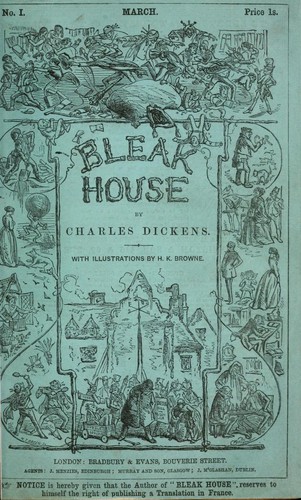
Bleak House
Charles Dickens (1853)
“A fog-bound masterpiece that invented the detective novel, condemned an entire legal system, and proved that institutions can kill as surely as any murderer.”
Bleak House— Summary & Analysis
by Charles Dickens · published 1853 · 950 pages · Victorian
A user-friendly study guide for Bleak House by Charles Dickens (1853): a high-level plot summary, full chapter-by-chapter analysis, theme breakdowns, character profiles, and 30 essay questions designed for ap-english, college readers. Unlike a stock summary, sumsumsum.com adds a diction analysis drawn from Charles Dickens’s actual text, the 5 documented AP Literature exam appearances of this book, and reading-difficulty guidance (Moderate, 4/10) so students, teachers, and lifelong readers know what they are walking into.
“A fog-bound masterpiece that invented the detective novel, condemned an entire legal system, and proved that institutions can kill as surely as any murderer.”
Short Summary
The interminable Chancery Court case of Jarndyce and Jarndyce devours everyone it touches. Esther Summerson, an orphan raised in shame, becomes ward of the benevolent John Jarndyce alongside cousins Richard Carstone and Ada Clare. As Richard spirals into obsession with the lawsuit, a parallel mystery unfolds: Lady Dedlock, wife of an aristocrat, harbors a secret connection to Esther. The lawyer Tulkinghorn investigates, is murdered, and Inspector Bucket — one of fiction's first detectives — unravels the threads. The case finally resolves when the entire estate has been consumed in legal costs, Richard dies broken, and Esther discovers her true identity while building a quiet, honest life outside the system that destroyed so many.
Detailed Summary
Bleak House opens in fog — literal and metaphorical. The Court of Chancery sits at the center of London like a spider in its web, processing the case of Jarndyce and Jarndyce, a disputed inheritance that has dragged on for so many generations that no one alive remembers its original purpose. The cos...
Summary in the Author’s Writing Style
A retelling of Bleak House in Charles Dickens’s style — so you can hear the language, not just the plot. This is a stylistic pastiche written by sumsumsum, not an excerpt from the book.
Fog everywhere. Fog up the river, where it rolls defiled among the tiers of shipping; fog down the river, where it presses against the gunwales of barges; fog in the eyes and throats of the wheezing pensioners by the workhouse fire; and fog, thickest of all, in the high Court of Chancery, where the …
Chapter-by-Chapter Analysis
If you liked Bleak House, read next
Start with Middlemarch by George Eliot — The other candidate for greatest Victorian novel — equally complex social web, but Eliot dissects psychology where Dickens dissects institutions. Or pivot to The Woman in White by Wilkie Collins — Collins learned the detective plot and the dual narration from Bleak House and streamlined both into the first sensation novel.
For comparative essays, pair Bleak House with
The strongest comparative pairing is The Trial (Franz Kafka) — Chancery becomes literally unnameable — Kafka's bureaucratic nightmare is Bleak House stripped of all hope that the system can be reformed.
Each of these pairings opens a clean thesis path on shared themes, period diction, or formal influence — useful for AP Lit / IB / first-year college comparative essays.
More from Charles Dickens and the scholars who study Dickens
Other works by Charles Dickens: A Tale of Two Cities (1859, 489 pages), David Copperfield (1850, 882 pages), Great Expectations (1861, 544 pages), Oliver Twist (1838, 554 pages). Reading two or three of these in sequence reveals Charles Dickens’s recurring obsessions and stylistic signatures more clearly than any single book can.
The standard scholarly entry points to Charles Dickens’s work: Peter Ackroyd (British literary biographer) — Dickens (1990); Michael Slater (Birkbeck, University of London, Emeritus) — Charles Dickens: A Life Defined by Writing (2009); Edgar Johnson (City College of New York) — Charles Dickens: His Tragedy and Triumph (1952). These are the works graduate seminars cite when teaching Charles Dickens.