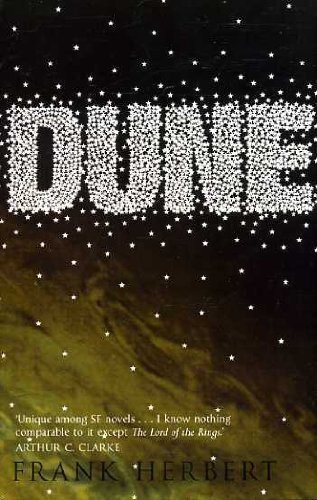
Dune
Frank Herbert (1965)
“The greatest science fiction novel ever written — a desert planet, a chosen boy, and a prophecy that might be the galaxy's greatest manipulation.”
This page prints on a single page. Use Ctrl+P / Cmd+P.
Dune
Frank Herbert (1965) · 688pages · New Wave Science Fiction · 4 AP appearances
Summary
On the desert planet Arrakis — the only source of the spice mélange, the most valuable substance in the universe — young Paul Atreides is thrust into a deadly political trap when his family is ordered to govern the planet. Betrayed by a rival House and left for dead, Paul and his mother Jessica flee into the deep desert and find refuge among the Fremen, the planet's fierce indigenous people. Paul discovers he may be the prophesied messiah the Fremen have waited generations for — or a carefully engineered product of manipulation. He masters the desert, rides the great sandworms, and leads the Fremen to revolution — but his victory comes at the cost of setting an interstellar holy war into motion he cannot stop.
Why It Matters
Dune is the best-selling science fiction novel of all time — over 20 million copies sold, continuously in print since 1965. It won both the Hugo Award (science fiction's highest honor) and the first Nebula Award in 1966. It invented ecological world-building as a literary practice — no science fi...
Themes & Motifs
Diction & Style
Register: Formal, scholarly, with technical worldbuilding vocabulary drawn from Arabic, Persian, Hebrew, Berber, and ecological science
Narrator: Third-person omniscient, shifting freely between Paul, Jessica, the Baron, Kynes, Chani, and multiple secondary chara...
Figurative Language: High
Historical Context
1960s America — Cold War, decolonization movements, environmental awakening, counterculture: Dune absorbed multiple 1960s crises simultaneously. The Fremen insurgency is Vietnam; Paul is both JFK (charismatic leader, killed before his project is realized in successors) and Lawrence of Arab...
Key Characters
Talking Points
- Herbert said explicitly that Dune is a warning against messiahs, not a celebration of them. Re-read the ending. Do you read it as a warning or as a triumph? What in the text supports each reading?
- The Bene Gesserit planted messianic prophecies in Fremen culture generations before Paul arrived. Does knowing the prophecy is manufactured make it less real for the Fremen? Does it change your view of Paul's authority?
- Why does Herbert draw so heavily on Arabic, Persian, and Islamic culture for Fremen language and religion? Is this respectful homage, appropriation, allegory, or something more complicated?
- Paul can see the jihad coming and cannot stop it. Does this make him morally responsible for the twelve billion deaths that follow? Does foresight create obligation?
- The Litany Against Fear is the novel's most quoted passage. Is it good philosophy? Is fear actually the mind-killer, or does fear sometimes lead to better decisions than rational calculation?
Notable Quotes
“I must not fear. Fear is the mind-killer. Fear is the little-death that brings total obliteration. I will face my fear. I will permit it to pass ov...”
“A beginning is the time for taking the most delicate care that the balances are correct.”
“The mystery of life isn't a problem to solve, but a reality to experience.”
Why Read This
Because it is the most complex world-building project in English literature, and all of it is in service of ideas — about power, ecology, religion, and the danger of following charismatic leaders. Every system in the novel (the spice economy, the ...