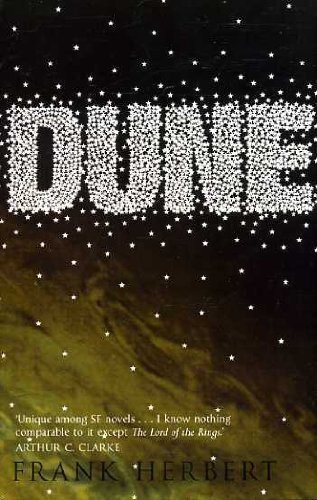
Dune
Frank Herbert (1965)
“The greatest science fiction novel ever written — a desert planet, a chosen boy, and a prophecy that might be the galaxy's greatest manipulation.”
Dune— Summary & Analysis
by Frank Herbert · published 1965 · 688 pages · New Wave Science Fiction
A user-friendly study guide for Dune by Frank Herbert (1965): a high-level plot summary, full chapter-by-chapter analysis, theme breakdowns, character profiles, and 30 essay questions designed for high-school, ap-english, college readers. Unlike a stock summary, sumsumsum.com adds a diction analysis drawn from Frank Herbert’s actual text, the 4 documented AP Literature exam appearances of this book, and reading-difficulty guidance (Easy, 3/10) so students, teachers, and lifelong readers know what they are walking into.
“The greatest science fiction novel ever written — a desert planet, a chosen boy, and a prophecy that might be the galaxy's greatest manipulation.”
Short Summary
On the desert planet Arrakis — the only source of the spice mélange, the most valuable substance in the universe — young Paul Atreides is thrust into a deadly political trap when his family is ordered to govern the planet. Betrayed by a rival House and left for dead, Paul and his mother Jessica flee into the deep desert and find refuge among the Fremen, the planet's fierce indigenous people. Paul discovers he may be the prophesied messiah the Fremen have waited generations for — or a carefully engineered product of manipulation. He masters the desert, rides the great sandworms, and leads the Fremen to revolution — but his victory comes at the cost of setting an interstellar holy war into motion he cannot stop.
Detailed Summary
The Padishah Emperor Shaddam IV assigns House Atreides — led by Duke Leto Atreides, his Bene Gesserit concubine Lady Jessica, and their fifteen-year-old son Paul — to govern Arrakis, the desert planet and sole source of the spice mélange. The spice enables interstellar navigation and extends human c...
Summary in the Author’s Writing Style
A retelling of Dune in Frank Herbert’s style — so you can hear the language, not just the plot. This is a stylistic pastiche written by sumsumsum, not an excerpt from the book.
A beginning is the time for taking the most delicate care that the balances are correct, and so it was that the Padishah Emperor Shaddam IV, whose every word was a current in the hidden river of empire, gave the desert world of Arrakis into the keeping of House Atreides — Duke Leto, who was loved; t…
Chapter-by-Chapter Analysis
If you liked Dune, read next
Start with The Left Hand of Darkness by Ursula K. Le Guin — The other great 1960s SF epic built on anthropological research — Le Guin's Gethen is Dune's Arrakis in rigor and cultural completeness, but Le Guin centers gender where Herbert centers ecology. Then try Childhood's End by Arthur C. Clarke — Messianic transformation at civilizational scale — but Clarke embraces transcendence; Herbert is terrified of it. Or pivot to The Dispossessed by Ursula K. Le Guin — Another science fiction novel structured as a critique of its own apparent values — Le Guin's Anarres is as ambivalent as Herbert's Arrakis.
For comparative essays, pair Dune with
The strongest comparative pairing is Foundation (Isaac Asimov) — Galactic empire collapse, one man navigating civilizational crisis — but Asimov is optimistic about rational planning; Herbert is deeply skeptical of anyone who thinks they can guide history.
Each of these pairings opens a clean thesis path on shared themes, period diction, or formal influence — useful for AP Lit / IB / first-year college comparative essays.