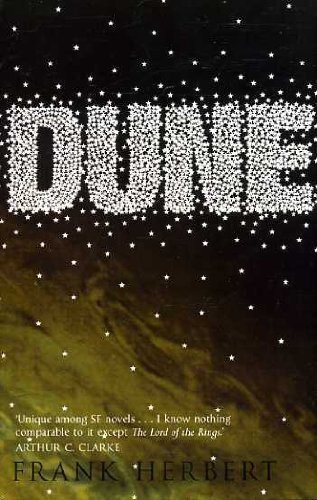
Dune
Frank Herbert (1965)
“The greatest science fiction novel ever written — a desert planet, a chosen boy, and a prophecy that might be the galaxy's greatest manipulation.”
Why This Book Matters
Dune is the best-selling science fiction novel of all time — over 20 million copies sold, continuously in print since 1965. It won both the Hugo Award (science fiction's highest honor) and the first Nebula Award in 1966. It invented ecological world-building as a literary practice — no science fiction or fantasy novel before Dune had designed a planet as a complete ecological system and made that system the engine of the plot. It established the template for the epic fantasy and science fiction genre as practiced by George Lucas (Star Wars draws heavily on Dune's mythology), James Cameron, and dozens of major franchise creators. And it did all of this while consistently resisting the heroic narrative it appears to be telling.
Firsts & Innovations
First science fiction novel to be built on ecological science as primary world-building framework
First science fiction novel to systematically draw on Islamic culture and Arabic linguistics as source material rather than Orientalist pastiche
First science fiction novel to genuinely deconstruct the 'chosen one' narrative from within — Paul is the messiah and the critique of messianism simultaneously
Established the 'glossary model' of world-building — extensive appendices and glossaries as part of the reading experience
Cultural Impact
Star Wars (1977) draws extensively on Dune: desert planet (Arrakis → Tatooine), chosen boy with special abilities, ancient sisterhood, mystical substance, desert warriors. Lucas has acknowledged the influence.
The spice allegory is the dominant framework for resource-war science fiction — every story about a finite crucial resource in a galaxy-spanning civilization is downstream of Dune
Fremen culture's synthesis of Islamic and North African elements influenced how science fiction depicts non-Western cultures — with research rather than exoticism
Herbert's ecological framework influenced real ecological thinking in the 1970s — Dune readers overlapped significantly with early environmental movement activists
The Bene Gesserit became the template for all subsequent depictions of female power organizations in science fiction and fantasy
Two film adaptations (1984 David Lynch, 2021-2024 Denis Villeneuve) and a TV miniseries — the 2021-2024 Villeneuve films are among the most praised science fiction films ever made
Banned & Challenged
Not widely banned, but frequently challenged in school settings for religious content (the messianic narrative is read as either pro-Islamic or anti-Christian depending on the challenger), for its depictions of drug-like effects of the spice, and for its implicit critique of American foreign policy and resource imperialism, which some school boards have considered politically inappropriate.