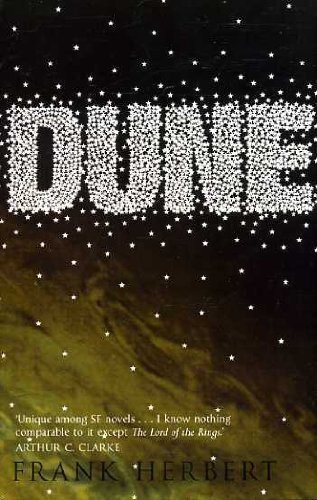
Dune
Frank Herbert (1965)
“The greatest science fiction novel ever written — a desert planet, a chosen boy, and a prophecy that might be the galaxy's greatest manipulation.”
Language Register
Formal, scholarly, with technical worldbuilding vocabulary drawn from Arabic, Persian, Hebrew, Berber, and ecological science
Syntax Profile
Herbert writes long, complex sentences with embedded clauses and frequent use of apposition to layer information. His paragraphs are dense and rarely shorter than five lines. Dialogue is formal across all characters — Herbert's characters speak as if aware of being recorded. The epigraphs (fictional future-texts opening each chapter) use an even more elevated register than the narrative, creating a prose hierarchy: most elevated (epigraph) → narrative → dialogue → Fremen speech (which has its own slightly different formality). This hierarchy mirrors the novel's social hierarchy and the distance between myth and event.
Figurative Language
High — but ecological rather than decorative. Herbert's metaphors are drawn from desert phenomena (wind, sand, water, worm) and applied to human situations, so the figurative language doubles as worldbuilding. Prescience is described through desert navigation metaphors: 'sailing' through possible futures, a 'horizon' of probability. Power is described through resource metaphors: hoarding, extraction, flow.
Era-Specific Language
The spice — the most valuable substance in the universe, enabling prescience, interstellar travel, and life extension. French for 'mixture,' suggesting its multifaceted function.
The female sisterhood of mental and physical discipline — from the Latin 'bene' (well) and 'gesserit' (she will have borne/managed). A centuries-old institution of selective breeding and political manipulation.
From the Hebrew 'Kefitzat Haderech' — 'shortening of the path.' The Bene Gesserit's goal: a male who can access both male and female ancestral memory lines, and navigate possibility itself.
Needle coated with metacyanide — held to the neck during the human consciousness test. 'Gom jabbar' in Fremen: 'high-handed enemy' or 'specific device which kills only animals.' The name implies the test's verdict if failed.
Arabic: 'the voice from the outer world.' The Fremen messianic title planted by the Bene Gesserit Missionaria Protectiva. Directly echoes Islamic prophetic traditions.
Arabic: 'the rightly guided one.' Another title for the expected Fremen messiah — directly drawn from Islamic eschatology. Herbert is explicit about the borrowing.
Fremen cave fortress community. From North African Berber dialects. A complete social unit with its own water supply, leadership, religious practice, and defensive culture.
Fremen garment that reclaims 99.9% of body moisture through micro-filtration. Technologically complex, culturally indispensable, and an index of survival skill — wearing one badly is a social marker.
A device that beats rhythmically into the sand to attract sandworms. Used both as bait and as transport — worm riding requires a thumper to summon the worm.
Fremen name for the great sandworm — 'Old Man of the Desert,' 'Grandfather of the Desert.' From the Arabic 'shaykh' and Persian 'hulud' (eternity). Both a physical animal and a religious concept.
How Characters Speak — Class & Identity
Paul Atreides / Muad'Dib
Begins with noble formality (Leto's court register), shifts to Fremen directness after desert integration, ends in messianic abstraction — speaking in third person at moments of highest power.
The language transformation tracks Paul's identity transformation. Each register is authentic to its context; none is his 'real' voice, which is the novel's point about constructed identity.
Lady Jessica
Precise, controlled, careful — every word chosen. Bene Gesserit training means she is always aware of how her speech is landing. She can modulate to any register as a tool.
The Bene Gesserit treat language as technology. Jessica's speech is always performance and is never 'just' speech.
Baron Harkonnen
Ironic, self-aware, occasionally self-deprecating — he jokes about his own monstrousness. Uses formal address as a form of contempt.
The Baron doesn't believe in his own ideology. He operates through power rather than conviction, and his language reveals it.
Stilgar
Direct, economical, ritual-aware — the speech of a desert leader who knows every word costs moisture. Proverbs and shared formulas structure Fremen social interaction.
Fremen speech is shaped by scarcity. Eloquence is efficiency. The most respected speech is the most concise.
Princess Irulan
Academic, retrospective, formal — her voice appears only in epigraphs in this novel, writing history after the fact.
Irulan is the novel's meta-narrator: she is writing the myth while Paul is living it. Her voice is always the voice of aftermath.
Narrator's Voice
Third-person omniscient, shifting freely between Paul, Jessica, the Baron, Kynes, Chani, and multiple secondary characters. Herbert does not privilege any single perspective — each character's interiority is rendered with equal seriousness. This is unusual: most epic fantasy or science fiction uses a single POV protagonist. Herbert's shifting omniscience is a political choice: it refuses to let any one character's perspective organize reality, including Paul's. The reader is never entirely inside the messiah; we always have access to how others see him.
Tone Progression
Book One: Dune
Urgent, conspiratorial, initiatory
Political trap being set. Paul's consciousness awakening. The desert being encountered for the first time — disorienting, beautiful, lethal.
Book Two: Muad'Dib
Dualisted — grandiose in the sietch, grotesque in the Baron's court
Paul becoming mythic in the desert; Harkonnen consolidation making the political stakes concrete. The two halves of the novel's moral universe presented in alternation.
Book Three: The Prophet
Prophetic, inevitable, elegiac
The future closing in. Paul's prescience narrowing his options. The tone of a man walking toward a door he cannot avoid opening.
Stylistic Comparisons
- T.E. Lawrence's Seven Pillars of Wisdom — Herbert cited Lawrence as a key influence; the desert guerrilla warfare, the English officer becoming a leader of Arab fighters, the ambivalence about the role
- J.R.R. Tolkien — epic scope and invented languages, but where Tolkien builds mythology, Herbert deconstructs it
- Isaac Asimov's Foundation — galactic empire collapse, psychohistory as prescience, one man navigating civilizational crisis; Herbert is more pessimistic about the navigator's ability to control the outcome
Key Vocabulary from This Book
Notable words used in this text — click to see full definitions