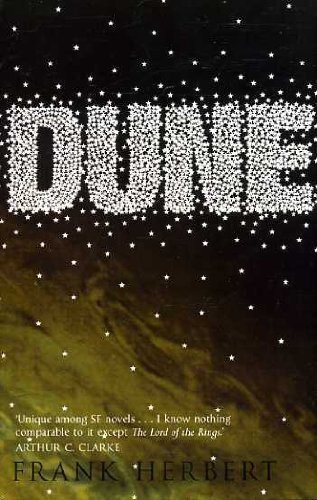
Dune
Frank Herbert (1965)
“The greatest science fiction novel ever written — a desert planet, a chosen boy, and a prophecy that might be the galaxy's greatest manipulation.”
For Students
Because it is the most complex world-building project in English literature, and all of it is in service of ideas — about power, ecology, religion, and the danger of following charismatic leaders. Every system in the novel (the spice economy, the Fremen culture, the Bene Gesserit breeding program) is philosophically coherent. You don't just read Dune; you study it. And Herbert leaves enough unanswered that re-reading it at twenty and at thirty are entirely different experiences.
For Teachers
The political and ecological frameworks are dense enough to sustain college-level analysis. The colonial allegory (Fremen as colonized people, spice as oil) is unambiguous enough to be accessible at the high school level. The messiah narrative is complex enough that students can genuinely disagree about whether Paul is a hero or a warning. And the vocabulary study alone — Arabic, Hebrew, Persian, Berber roots — is a legitimate cultural education.
Why It Still Matters
The spice is oil. Arrakis is the Middle East. The Fremen are every indigenous people whose land contains something the empire wants. Paul is every charismatic Western-educated figure who leads a Third World insurgency to independence and then, in Herbert's telling, turns that independence into something darker. Dune was published in 1965 and describes 2025 geopolitics with precision that borders on the prophetic — which is exactly what Herbert, who understood prescience was just careful observation of systems, would have expected.