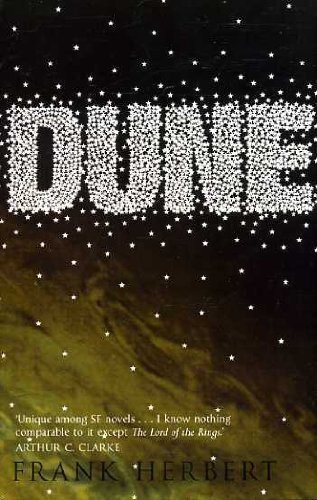
Dune
Frank Herbert (1965)
“The greatest science fiction novel ever written — a desert planet, a chosen boy, and a prophecy that might be the galaxy's greatest manipulation.”
Dune— Historical Context & Author Background
Author: Frank Herbert · Published 1965· Era: New Wave Science Fiction·688 pages
Themes explored: power, ecology, religion, fate, colonialism, leadership, survival, messiah
About Frank Herbert
Frank Herbert (1920–1986) was a journalist, ecologist, and science fiction writer from Tacoma, Washington. He spent years researching an article about U.S. Department of Agriculture efforts to stabilize Oregon's sand dunes using poverty grass and European beach grass — an ecological project to arrest the dunes' movement. The article was never published, but the research became Dune. Herbert was also deeply interested in ecology, Zen Buddhism, Sufism, and the psychological mechanisms of charisma — particularly how people surrender judgment to charismatic leaders. He spent six years writing Dune; it was rejected by twenty-three publishers before Chilton Books (a car repair manual publisher) accepted it. It won the Hugo and Nebula Awards in 1966.
Life → Text Connections
How Frank Herbert's real experiences shaped specific elements of Dune.
Herbert's sand dunes research — stabilizing mobile dunes through introduced plant species
The Fremen's multigenerational terraforming project — introducing plant species, modifying the water cycle, slowly converting Arrakis to a green world
Dune's ecological detail is not metaphorical — it's based on real ecological science. The terraforming plan is botanically coherent. Herbert understood that ecological transformation is slow, generational work, not a heroic act.
Herbert's research into Sufism, Islam, and T.E. Lawrence's Seven Pillars of Wisdom
The Fremen culture, the messianic prophecy, Paul's role as an outsider leading a desert people
The parallel to Lawrence is not accidental. Herbert was writing about the mechanism of charismatic leadership in colonized cultures — how a sufficiently skilled outsider can take over a revolutionary movement and redirect it. He intended Paul as a critique, not a celebration.
Herbert's interest in how populations surrender authority to leaders
The novel's ending — Paul winning everything and setting a jihad into motion he cannot stop
Herbert said explicitly that Dune is a warning against messiahs. He wanted readers to be seduced by Paul and then confront the cost of that seduction. The novel is about how heroic narratives make atrocity possible.
The 1960s oil crisis forming on the horizon — Herbert was writing as OPEC's power was becoming visible
Arrakis as the sole source of mélange, the spice cartel, the Great Houses dependent on one planet's resource
The allegory is oil, clearly — but Herbert extends it. The spice is also any finite resource that a civilization builds its entire structure around, making it hostage to whoever controls the source.
Historical Era
1960s America — Cold War, decolonization movements, environmental awakening, counterculture
How the Era Shapes the Book
Dune absorbed multiple 1960s crises simultaneously. The Fremen insurgency is Vietnam; Paul is both JFK (charismatic leader, killed before his project is realized in successors) and Lawrence of Arabia (outsider colonizer who becomes the icon of colonized peoples). The ecological framework is Silent Spring writ large — what happens when the only planet producing a crucial substance is destroyed by extraction? The Cold War's logic of mutually assured destruction appears as Paul's spice-destruction threat. Herbert was not making allegory; he was asking: what do all these crises look like from a thousand years out?
Why Dune Matters Historically
Dune is the best-selling science fiction novel of all time — over 20 million copies sold, continuously in print since 1965. It won both the Hugo Award (science fiction's highest honor) and the first Nebula Award in 1966. It invented ecological world-building as a literary practice — no science fiction or fantasy novel before Dune had designed a planet as a complete ecological system and made that system the engine of the plot. It established the template for the epic fantasy and science fiction genre as practiced by George Lucas (Star Wars draws heavily on Dune's mythology), James Cameron, and dozens of major franchise creators. And it did all of this while consistently resisting the heroic narrative it appears to be telling.
- First science fiction novel to be built on ecological science as primary world-building framework
- First science fiction novel to systematically draw on Islamic culture and Arabic linguistics as source material rather than Orientalist pastiche
- First science fiction novel to genuinely deconstruct the 'chosen one' narrative from within — Paul is the messiah and the critique of messianism simultaneously
- Established the 'glossary model' of world-building — extensive appendices and glossaries as part of the reading experience
Not widely banned, but frequently challenged in school settings for religious content (the messianic narrative is read as either pro-Islamic or anti-Christian depending on the challenger), for its depictions of drug-like effects of the spice, and for its implicit critique of American foreign policy and resource imperialism, which some school boards have considered politically inappropriate.