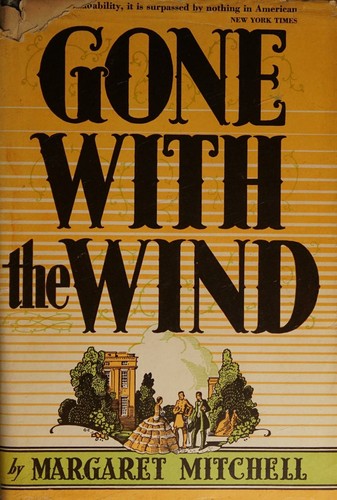
Gone with the Wind
Margaret Mitchell (1936)
“A thousand-page monument to one woman's refusal to be destroyed -- and a deeply uncomfortable window into how America romanticized its own worst history.”
Characters in Gone with the Wind
by Margaret Mitchell · 1936 · 8 characters analyzed
Cast: Scarlett O'Hara, Rhett Butler, Ashley Wilkes, Melanie Hamilton Wilkes, Mammy, Gerald O'Hara, Ellen O'Hara, Belle Watling.
Character Analysis
Selfish, magnetic, indestructible. Scarlett survives everything -- war, starvation, widowhood, social exile -- through sheer refusal to accept defeat. Her fatal flaw is not selfishness but blindness: she cannot distinguish between what she wants and what she needs, between the fantasy of Ashley and the reality of Rhett. She is the novel's argument that survival and morality are separate skills, and that possessing one does not guarantee the other.
Proper Southern speech in public that slips into blunt directness in private. Internal monologue is modern, impatient, transactional. Her language becomes coarser as the novel progresses -- reflecting her transformation from belle to businesswoman.
The only character who sees through every performance -- Scarlett's charm, Ashley's honor, the Cause itself. His tragedy is that clear sight does not protect against love. He falls for Scarlett knowing exactly who she is, and spends years hoping she'll change. When she finally does, he has nothing left to give. Rhett is the novel's answer to the question of whether intelligence can prevent heartbreak.
Educated, witty, deliberately provocative. Uses polished English to deliver uncomfortable truths. Drops the irony only in moments of genuine emotion -- the proposal, Bonnie's death, the final departure.
The old South in human form -- cultured, gentle, paralyzed. Ashley understands that his world is doomed and cannot act on that understanding. He is everything Scarlett thinks she wants and nothing she actually needs. His function in the novel is to be the beautiful distraction that prevents Scarlett from seeing Rhett clearly.
Literary, allusive, deliberately vague. Speaks in abstractions rather than specifics. References poetry and philosophy where other characters reference practical reality.
The novel's quietly strongest character. Melanie's gentleness is not weakness -- she defends Scarlett against society, stands by her through scandal, and dies still believing in her. She is the only character whose goodness is genuine rather than performed. The novel's deepest tragedy may be Scarlett's failure to recognize Melanie's love until it's too late.
Gentle, precise, always generous. Never uses language to wound, manipulate, or perform. Her speech is the quietest in the novel and the most consistent.
Mitchell's most psychologically complex Black character, and also her most problematic. Mammy is wise, fierce, loyal, and completely defined by her relationship to a white family. She has no last name, no independent desires, no life outside the O'Haras. She is simultaneously the novel's conscience and its most damaging racial construction -- the 'faithful slave' who loves her enslavers more than freedom.
Rendered in heavy phonetic dialect -- 'Ah,' 'doan,' 'mah,' 'chile.' Within this imposed dialect, Mitchell gives Mammy moral authority, sharp judgment, and emotional range that exceed any other character's.
Irish immigrant who won Tara in a poker game -- proof that the planter aristocracy was less aristocratic than it pretended. Gerald's bombast and sentimentality mask genuine shrewdness. His mental collapse after Ellen's death mirrors the collapse of the patriarchal order he embodied.
Irish-inflected English with moments of bluster and sentimentality. His grammar is occasionally rough, reflecting his immigrant origins, but his rhetoric is persuasive.
The perfect Southern lady -- serene, self-sacrificing, endlessly competent. Ellen dies before the novel's midpoint, but her ghost haunts every page. She represents the standard Scarlett can never meet and the world the war destroyed. Her death is the death of the old order's feminine ideal.
Atlanta's most notorious madam and Rhett's confidante. Belle occupies the novel's moral margin -- too honest for respectable society, too generous for the role of villain. Her secret donation to the Confederate hospital and her protection of the Klan riders reveal a patriotism that polite society will never acknowledge. She is Scarlett's mirror: both women survive by trading on what men want.
Coarse, direct, unashamed. Speaks without euphemism about money, sex, and social reality. Her grammar marks her lower-class origins.