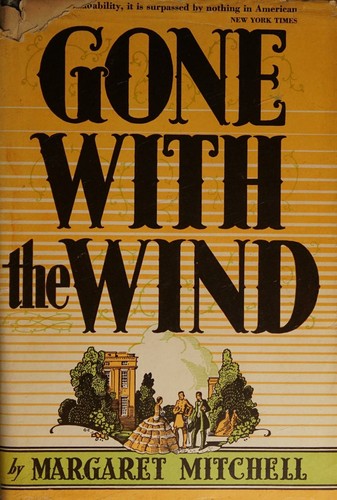
Gone with the Wind
Margaret Mitchell (1936)
“A thousand-page monument to one woman's refusal to be destroyed -- and a deeply uncomfortable window into how America romanticized its own worst history.”
Essay Questions & Food for Thought
30questions designed to challenge assumptions and provoke original thinking. These can't be answered from a summary — you need the actual text.
Mitchell's narrator shares the racial assumptions of her white characters -- using terms like 'darkies' without ironic distance and presenting enslaved people as members of the 'family.' How does this narrative alignment affect your ability to trust the novel's other claims?
Scarlett marries three times -- for spite, for money, and for security/passion. What does each marriage reveal about her, and how does Mitchell use the marriages to track Scarlett's evolution?
Mammy is arguably the novel's moral center -- the character who most consistently distinguishes right from wrong. How does this moral authority coexist with her status as an enslaved/formerly enslaved person with no agency of her own?
Rhett tells Scarlett early on that they are alike -- both realists in a world of sentimentalists. Is he right? Where do they differ, and what does the difference cost them?
Why does Mitchell make Ashley Wilkes attractive and sympathetic rather than simply weak? What would the novel lose if Ashley were obviously unworthy of Scarlett's obsession?
The novel presents Reconstruction as a humiliation inflicted on the South. Compare Mitchell's version with historical accounts. What does the novel omit, distort, or invent?
Scarlett's vow -- 'I'll never be hungry again' -- drives everything she does after Tara. Is survival a sufficient moral justification for her subsequent actions? Where, if anywhere, does she cross a line?
Mitchell wrote Gone with the Wind during the Great Depression. How does the Depression context shape a novel set in the 1860s? What would 1930s readers have recognized in Scarlett's hunger?
Melanie Hamilton is consistently underestimated by Scarlett. Trace three moments where Melanie demonstrates strength that Scarlett fails to recognize. Why is Scarlett blind to it?
The novel romanticizes the Ku Klux Klan in the Frank Kennedy chapters. How should a modern reader approach this material? Is it possible to appreciate the novel's literary achievements while condemning its racial politics?
Compare Scarlett and Rhett's relationship to a toxic modern relationship. What dynamics -- the push-pull, the weaponized vulnerability, the inability to be honest -- translate directly?
Why does Rhett abandon Scarlett on the road from Atlanta to join the Confederate army he has spent years mocking? Is this consistent with his character?
Scarlett's relationship with the land -- specifically Tara's red earth -- is presented as deeper and more reliable than any human connection. What does this say about Mitchell's view of love?
Alice Randall's The Wind Done Gone retells the story from the perspective of a mixed-race enslaved woman. Why was this retelling necessary? What does it restore that Mitchell erased?
Mitchell was an independent woman who worked as a journalist and scandalized Atlanta society. How does her personal history appear in Scarlett's characterization? Where does Mitchell seem to agree with Scarlett, and where does she judge her?
The novel contains no battle scenes -- the entire Civil War is experienced through the women on the home front. How does this perspective challenge or reinforce the traditional war narrative?
Rhett's famous exit line -- 'My dear, I don't give a damn' -- is usually read as a witty dismissal. Read it in context. Is Rhett being witty or devastated? What has been lost from his voice?
Mitchell presents Gerald O'Hara -- an Irish immigrant who won his plantation in a poker game -- as a founding patriarch of the planter aristocracy. What does this origin story say about the 'aristocratic' South?
Bonnie Blue Butler's death is the event that finally destroys the Butler marriage. Why does Mitchell kill a child to achieve this? Could any other loss have had the same effect?
The novel's title comes from Ernest Dowson's poem 'Cynara' -- 'I have forgot much, Cynara! gone with the wind.' What is 'gone with the wind' in the novel? What has been lost, and does Mitchell mourn it honestly?
Scarlett cannot distinguish between love and obsession until the final pages. Is her realization about Ashley and Rhett genuine growth, or just another form of wanting what she can't have?
Compare Scarlett O'Hara and Becky Sharp from Thackeray's Vanity Fair. Both are ambitious women who manipulate men and defy social convention. How do their creators judge them differently?
The curtain dress scene -- Scarlett making a gown from velvet curtains to seduce Rhett for money -- is one of the novel's most famous moments. What does it symbolize about Scarlett's relationship to the old South?
Hattie McDaniel won the first Academy Award ever given to a Black American for playing Mammy -- and was forced to sit at a segregated table at the ceremony. What does this fact tell us about how America consumes stories about race?
Is 'Tomorrow is another day' a hopeful ending or a tragic one? Make a case for each reading using evidence from the novel.
Mitchell wrote no sequel and refused all requests to continue Scarlett's story. Why? What does the refusal tell us about what the novel is really about?
Compare Mitchell's treatment of war to Hemingway's in A Farewell to Arms or Remarque's in All Quiet on the Western Front. How does the home-front perspective create a different kind of anti-war statement?
The novel's enslaved characters who remain loyal to the O'Haras are presented positively; those who leave are presented negatively. What narrative purpose does this distinction serve, and what reality does it erase?
Scarlett and Melanie represent two models of feminine strength -- one aggressive and visible, one quiet and invisible. Does the novel ultimately value one over the other?
If Gone with the Wind were published today for the first time -- same text, same content -- what would the reception look like? What does the gap between 1936 reception and a hypothetical 2026 reception tell us about how cultural values change?