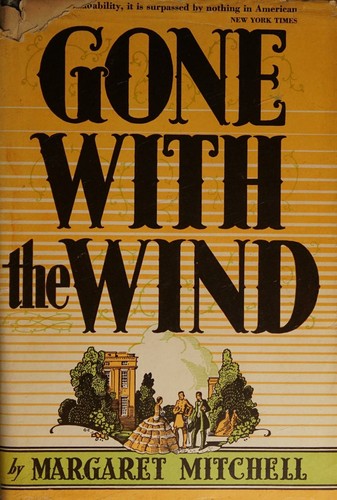
Gone with the Wind
Margaret Mitchell (1936)
“A thousand-page monument to one woman's refusal to be destroyed -- and a deeply uncomfortable window into how America romanticized its own worst history.”
Language Register
Elevated narrative voice with deep dialect variation in dialogue -- literary Southern English for narration, phonetically rendered dialect for Black characters and poor whites, studied gentility for the planter class
Syntax Profile
Long, rolling narrative sentences that mimic the oral storytelling tradition of the Southern novel. Mitchell averages 25+ words per sentence in narration, with extensive use of em-dashes, semicolons, and parenthetical asides. Dialogue is sharply differentiated by class and race -- the planter class speaks in complete, formal sentences; the yeoman farmers use contracted English; Black characters' speech is rendered in heavy phonetic dialect that exaggerates their pronunciation and grammar for white-audience legibility.
Figurative Language
Moderate -- Mitchell relies more on physical description and dramatic irony than on metaphor. Her strongest figurative work centers on the land (Tara's red earth as blood, identity, covenant) and on fire (Atlanta burning as the death of a civilization). Her prose is more cinematic than poetic -- she builds images rather than metaphors.
Era-Specific Language
Mitchell uses the racial terminology of her white characters without authorial distance -- the language itself encodes the racial hierarchy the novel takes for granted
Reconstruction-era political slurs -- 'carpetbagger' for Northern opportunists, 'scalawag' for Southern collaborators. Mitchell uses both without irony.
Smuggler who evaded the Union naval blockade to deliver goods to the Confederacy -- the source of Rhett's fortune and his social ambiguity
Class slurs used by the planter elite to distinguish themselves from non-slaveholding whites. Mitchell's class system is rigid and explicitly racial.
The Confederate cause -- always capitalized by Mitchell, treated with reverence by her characters and at least sympathy by her narrator
How Characters Speak — Class & Identity
Scarlett O'Hara
Proper Southern speech in public that slips into blunt directness in private. Internal monologue is modern, impatient, transactional. Her language becomes coarser as the novel progresses -- reflecting her transformation from belle to businesswoman.
Scarlett's speech reflects the gap between the world she was raised in and the world she actually inhabits. She performs gentility; she thinks in profit margins.
Rhett Butler
Educated, witty, deliberately provocative. Uses polished English to deliver uncomfortable truths. Drops the irony only in moments of genuine emotion -- the proposal, Bonnie's death, the final departure.
Rhett's language is armor. He uses sophistication the way Scarlett uses charm -- as a tool of control. When the armor cracks, the real Rhett is simpler and more vulnerable than the performance suggests.
Ashley Wilkes
Literary, allusive, deliberately vague. Speaks in abstractions rather than specifics. References poetry and philosophy where other characters reference practical reality.
Ashley lives in language the way he lives in memory -- at a remove from the present. His beautiful speech is a refuge from a world he cannot navigate.
Melanie Hamilton
Gentle, precise, always generous. Never uses language to wound, manipulate, or perform. Her speech is the quietest in the novel and the most consistent.
Melanie's language reflects her character: she is exactly what she appears to be. In a novel of performers, she is the only person whose speech and interior match perfectly.
Mammy
Rendered in heavy phonetic dialect -- 'Ah,' 'doan,' 'mah,' 'chile.' Within this imposed dialect, Mitchell gives Mammy moral authority, sharp judgment, and emotional range that exceed any other character's.
The dialect is Mitchell's, not Mammy's -- it marks racial difference for a white readership. But the intelligence and authority within the dialect reveal a character far more complex than the 'faithful slave' archetype Mitchell consciously intended.
Gerald O'Hara
Irish-inflected English with moments of bluster and sentimentality. His grammar is occasionally rough, reflecting his immigrant origins, but his rhetoric is persuasive.
Gerald's speech marks him as an outsider who has earned his place -- Irish, self-made, not quite a gentleman but powerful enough that it doesn't matter. His language is the sound of the New South before the war even begins.
Belle Watling
Coarse, direct, unashamed. Speaks without euphemism about money, sex, and social reality. Her grammar marks her lower-class origins.
Belle is the only woman in the novel who speaks as honestly as Rhett. Her social position frees her from the performance of respectability, and her language reflects that freedom.
Narrator's Voice
Third-person limited, closely aligned with Scarlett's perspective but occasionally pulling back into a broader Southern communal voice that romanticizes the world Scarlett inhabits. The narrator is not neutral -- it shares the racial and class assumptions of its characters, presenting the planter class with sympathy and the enslaved population with condescension. This lack of narrative distance is the novel's greatest strength as immersive storytelling and its greatest weakness as moral document.
Tone Progression
Chapters 1-7
Romantic, nostalgic, pastoral
The antebellum world rendered in golden light. The prose is lush and deliberately seductive -- Mitchell wants the reader to fall in love with a world that is about to be destroyed.
Chapters 8-23
Urgent, chaotic, increasingly desperate
War compresses the prose. Sentences shorten, images sharpen, the pastoral gives way to fire and blood. The most kinetic writing in the novel.
Chapters 24-36
Harsh, pragmatic, morally grey
Survival strips the romance from the prose. Mitchell writes about dirt, hunger, and money with a directness that matches Scarlett's transformation.
Chapters 37-57
Bitter, psychologically complex, darkening
The Reconstruction and marriage chapters are the most interior -- the drama moves from battlefields to drawing rooms, and the violence becomes emotional rather than physical.
Chapters 58-63
Elegiac, devastating, unresolved
The final chapters return to the lyricism of the opening, now weighted with loss. The circle closes, but nothing is restored.
Stylistic Comparisons
- Faulkner -- the other giant of Southern fiction, but where Faulkner fragments and obscures, Mitchell clarifies and dramatizes. Both write about the same lost world; Faulkner buries it in language, Mitchell stages it as spectacle.
- Tolstoy's War and Peace -- the obvious structural model. Both novels use a woman's survival across a national catastrophe as the spine of an epic. Both mix historical sweep with domestic intimacy.
- Daphne du Maurier's Rebecca -- published two years later, similarly built around a narrator who misreads the relationships around her until the final revelation restructures everything.
Key Vocabulary from This Book
Notable words used in this text — click to see full definitions