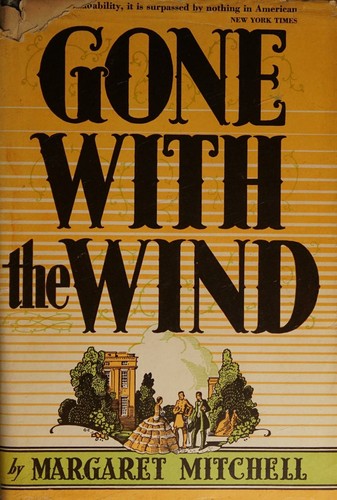
Gone with the Wind
Margaret Mitchell (1936)
“A thousand-page monument to one woman's refusal to be destroyed -- and a deeply uncomfortable window into how America romanticized its own worst history.”
This page prints on a single page. Use Ctrl+P / Cmd+P.
Gone with the Wind
Margaret Mitchell (1936) · 1037pages · Southern Gothic / Historical Fiction · 3 AP appearances
Summary
Scarlett O'Hara, the headstrong daughter of an Irish immigrant plantation owner in Georgia, navigates the destruction of the Civil War and Reconstruction by sheer ruthlessness and survival instinct. She marries three times -- first for spite, then for money, finally for passion -- while obsessively pursuing Ashley Wilkes, a man who represents the old South she's already outgrown. Her third husband, Rhett Butler, is the only man who sees through her, loves her anyway, and ultimately walks away when she destroys his capacity to care. By the end, Scarlett has lost nearly everything -- Rhett, her daughter Bonnie, Melanie's friendship -- but still believes she can get it all back tomorrow.
Why It Matters
The bestselling American novel of the twentieth century -- over 30 million copies sold worldwide. Won the Pulitzer Prize in 1937. The 1939 David O. Selznick film adaptation, starring Vivien Leigh and Clark Gable, became the highest-grossing film of all time (adjusted for inflation, it arguably st...
Themes & Motifs
Diction & Style
Register: Elevated narrative voice with deep dialect variation in dialogue -- literary Southern English for narration, phonetically rendered dialect for Black characters and poor whites, studied gentility for the planter class
Narrator: Third-person limited, closely aligned with Scarlett's perspective but occasionally pulling back into a broader Southe...
Figurative Language: Moderate -- Mitchell relies more on physical description and dramatic irony than on metaphor. Her strongest figurative work centers on the land (Tara's red earth as blood, identity, covenant) and on fire (Atlanta burning as the death of a civilization). Her prose is more cinematic than poetic -- she builds images rather than metaphors.
Historical Context
Civil War and Reconstruction (1861-1877), written from the perspective of 1930s white Southern nostalgia: The novel is set in the 1860s-1870s but written in the 1930s, and the Depression context matters as much as the Civil War setting. Mitchell wrote during an era of economic devastation when survival...
Key Characters
Talking Points
- Mitchell's narrator shares the racial assumptions of her white characters -- using terms like 'darkies' without ironic distance and presenting enslaved people as members of the 'family.' How does this narrative alignment affect your ability to trust the novel's other claims?
- Scarlett marries three times -- for spite, for money, and for security/passion. What does each marriage reveal about her, and how does Mitchell use the marriages to track Scarlett's evolution?
- Mammy is arguably the novel's moral center -- the character who most consistently distinguishes right from wrong. How does this moral authority coexist with her status as an enslaved/formerly enslaved person with no agency of her own?
- Rhett tells Scarlett early on that they are alike -- both realists in a world of sentimentalists. Is he right? Where do they differ, and what does the difference cost them?
- Why does Mitchell make Ashley Wilkes attractive and sympathetic rather than simply weak? What would the novel lose if Ashley were obviously unworthy of Scarlett's obsession?
Notable Quotes
“Scarlett O'Hara was not beautiful, but men seldom realized it when caught by her charm.”
“War, war, war; this war talk's spoiling all the fun at every party this spring. I get so bored I could scream.”
“You, sir, are no gentleman. -- And you, miss, are no lady.”
Why Read This
Because this is the novel that taught America its wrong history of the Civil War -- and you need to understand what that wrong history looks like from the inside. Scarlett O'Hara is one of the most compelling characters in fiction: selfish, brilli...