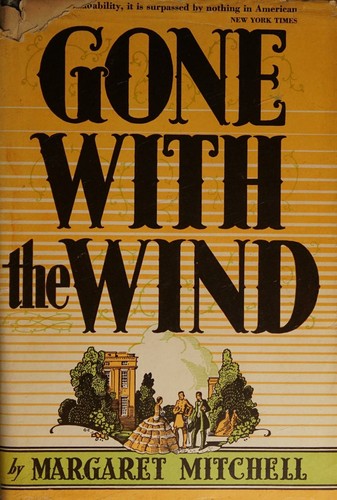
Gone with the Wind
Margaret Mitchell (1936)
“A thousand-page monument to one woman's refusal to be destroyed -- and a deeply uncomfortable window into how America romanticized its own worst history.”
Gone with the Wind— Historical Context & Author Background
Author: Margaret Mitchell · Published 1936· Era: Southern Gothic / Historical Fiction·1037 pages
Themes explored: survival, southern-identity, civil-war, gender-roles, race, love-obsession, class
About Margaret Mitchell
Margaret Munnerlyn Mitchell (1900-1949) was born and raised in Atlanta, Georgia, surrounded by Civil War stories told by relatives and Confederate veterans. Her grandmother had watched Sherman's army burn Atlanta from her porch. Mitchell was a tomboy who scandalized Atlanta society -- she smoked, performed a provocative Apache dance at a debutante ball, and worked as a journalist for the Atlanta Journal at a time when few women did. She began writing Gone with the Wind in 1926 while recovering from an ankle injury, and spent nearly a decade on it. The novel, her only book, won the Pulitzer Prize in 1937 and became the bestselling American novel of the twentieth century. Mitchell was struck by a car and killed in Atlanta in 1949 at age 48. She wrote no sequel and resisted all efforts to continue Scarlett's story.
Life → Text Connections
How Margaret Mitchell's real experiences shaped specific elements of Gone with the Wind.
Mitchell grew up hearing Civil War stories from elderly relatives who had lived through the burning of Atlanta and Reconstruction
The novel's visceral specificity about wartime Atlanta -- the siege, the hospitals, the burning -- comes from oral history transmitted across two generations
Gone with the Wind is not a researched historical novel but a transcription of family mythology. This explains both its emotional power and its historical distortions -- Mitchell inherited the Lost Cause narrative as family truth.
Mitchell was a fiercely independent woman who worked as a journalist, divorced her first husband, and chafed against Southern social expectations
Scarlett's refusal to accept feminine passivity, her business ambitions, her contempt for social convention
Scarlett is Mitchell's fantasy of female agency within a system designed to prevent it. Mitchell gave Scarlett the freedom she fought for in her own life -- and then showed its costs.
Mitchell grew up in a segregated Atlanta that celebrated the Confederacy. The United Daughters of the Confederacy were powerful social forces in her childhood.
The novel's uncritical adoption of Lost Cause mythology -- the noble South, the faithful slaves, the corrupt Reconstruction
Mitchell's racial politics were not personal aberrations but the mainstream views of her time, class, and place. The novel's racism is structural and inherited -- which makes it more insidious, not less.
Mitchell wrote the novel over nearly a decade while married to her second husband John Marsh, who served as editor and emotional support
The novel's sustained quality and psychological consistency across a thousand pages reflect years of revision and obsessive attention to detail
Gone with the Wind reads like a story told in a single breath, but it was painstakingly constructed. The seeming effortlessness of the narrative is the product of enormous labor -- a fact Mitchell, like Scarlett, would never admit.
Historical Era
Civil War and Reconstruction (1861-1877), written from the perspective of 1930s white Southern nostalgia
How the Era Shapes the Book
The novel is set in the 1860s-1870s but written in the 1930s, and the Depression context matters as much as the Civil War setting. Mitchell wrote during an era of economic devastation when survival was again a daily reality for millions -- Scarlett's hunger at Tara resonated with 1930s readers in ways that transcended the historical setting. The novel's racial politics also reflect 1930s America: Jim Crow was fully entrenched, the Lost Cause narrative was mainstream American history (taught in Northern schools as well as Southern), and challenging the plantation mythology was socially and sometimes physically dangerous. Mitchell's racial views were not brave contrarianism but comfortable consensus.
Why Gone with the Wind Matters Historically
The bestselling American novel of the twentieth century -- over 30 million copies sold worldwide. Won the Pulitzer Prize in 1937. The 1939 David O. Selznick film adaptation, starring Vivien Leigh and Clark Gable, became the highest-grossing film of all time (adjusted for inflation, it arguably still is). The novel defined popular understanding of the Civil War for generations, for better and (mostly) worse -- its Lost Cause mythology shaped how Americans understood Reconstruction until the civil rights movement forced a reckoning.
- One of the first American novels to center a female antiheroine -- Scarlett is selfish, manipulative, and utterly compelling
- Pioneered the wartime domestic perspective in popular fiction -- the war seen through women who survive it rather than men who fight it
- One of the first novels to treat Reconstruction as a narrative subject at epic scale, though its treatment is ideologically compromised
Challenged for racial language, romanticization of slavery, and positive portrayal of the Ku Klux Klan. HBO Max temporarily removed the 1939 film in 2020 during racial justice protests, then restored it with a contextual introduction. The novel remains on many school reading lists but is increasingly taught with critical framing about its racial politics rather than presented as straightforward historical fiction.