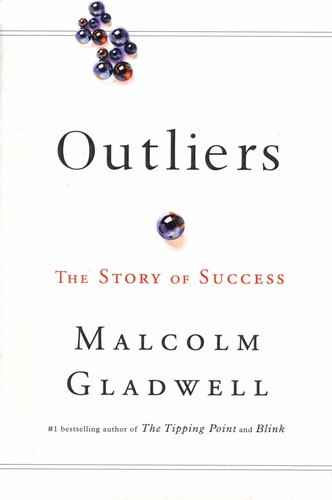
Outliers: The Story of Success
Malcolm Gladwell (2008)
“The book that shattered the myth of the self-made genius by revealing that extraordinary success is less about individual talent and more about hidden advantages, cultural legacies, and the 10,000-hour rule.”
Outliers: The Story of Success— Historical Context & Author Background
Author: Malcolm Gladwell · Published 2008· Era: Contemporary Social Science / Popular Nonfiction·309 pages
Themes explored: success, opportunity, culture, practice, timing, privilege, meritocracy
About Malcolm Gladwell
Malcolm Timothy Gladwell was born on September 3, 1963, in Fareham, Hampshire, England, to a Jamaican mother (a psychotherapist) and a British father (a mathematics professor). The family moved to Canada when Gladwell was six. He grew up in Elmira, Ontario, a small Mennonite farming community, where his mixed-race identity and academic family made him an outsider — an experience he has described as formative. Gladwell studied history at the University of Toronto, graduating in 1984. After a period of unsuccessful job searching (he was rejected by every advertising agency he applied to), he was hired by the American Spectator and then the Washington Post, where he covered business and science. In 1996, he joined The New Yorker as a staff writer, where he has remained. Gladwell's first book, The Tipping Point (2000), became a bestseller and established his reputation for making social science research accessible through narrative journalism. Blink (2002) followed, examining rapid cognition and snap judgments. Outliers (2008) was his third book and arguably his most influential. Gladwell's personal background — mixed-race, immigrant, academically oriented family, outsider childhood — directly informs Outliers' themes of structural advantage, cultural inheritance, and the myth of the self-made individual. The epilogue, in which he traces his own family's history of racial privilege and educational access in Jamaica, makes the autobiographical connection explicit.
Life → Text Connections
How Malcolm Gladwell's real experiences shaped specific elements of Outliers: The Story of Success.
Mixed-race Jamaican-British heritage and immigrant childhood in Canada
The epilogue tracing how racial hierarchy in Jamaica created educational opportunities for his family
Gladwell applies his own thesis to his own life, demonstrating that his career as a writer was made possible by structural advantages he did not earn.
Growing up in a Mennonite farming community as an outsider
The book's sensitivity to how cultural environments shape individual behavior and opportunity
Gladwell's outsider perspective — observing a tight-knit community from its margins — developed the ethnographic eye that characterizes his writing.
Career trajectory from rejected job applicant to New Yorker staff writer
The book's argument that timing and opportunity matter as much as talent
Gladwell's own career success depended on specific timing — joining the New Yorker at a moment when narrative nonfiction about social science was becoming commercially viable.
Mother's academic career as a psychotherapist
The comfort with psychological and sociological research that enables Gladwell to translate academic findings for general audiences
Growing up with a social scientist parent gave Gladwell the intellectual tools and the familiarity with research methods that distinguish his journalism from less rigorous popular nonfiction.
Historical Era
Late 2000s America — Financial Crisis, Meritocracy Debate, Growing Inequality Awareness (2008)
How the Era Shapes the Book
Outliers was published in November 2008, two months after the Lehman Brothers collapse. The financial crisis had just demonstrated, spectacularly, that expert judgment was unreliable, that structural advantages could be hidden inside apparently meritocratic systems, and that the narrative of individual responsibility failed to explain collective outcomes. Gladwell's argument — that success depends on structure, timing, and opportunity rather than individual merit alone — landed in an environment where the meritocratic narrative was already under severe strain.
Why Outliers: The Story of Success Matters Historically
Outliers permanently changed the popular conversation about success, talent, and meritocracy. The 10,000-hour rule entered common language. The structural critique of the self-made individual narrative influenced education policy, corporate diversity initiatives, and public discourse about inequality. The book made it acceptable — even fashionable — to question whether successful people deserve all the credit they receive.
- Popularized the 10,000-hour rule (subsequently debated but permanently influential) for a mass audience
- Introduced the concept of 'cumulative advantage' to popular discourse, showing how small initial differences compound into large outcome differences
- Made the structural critique of meritocracy accessible to a mainstream audience that had not previously encountered sociological arguments about opportunity and inequality
Not banned. However, the book has generated sustained academic criticism, particularly from Anders Ericsson (who argued Gladwell oversimplified his research on deliberate practice) and from scholars who challenge the cultural determinism of the Korean Air and rice-paddy chapters. These critiques are substantive and should be engaged with by readers.