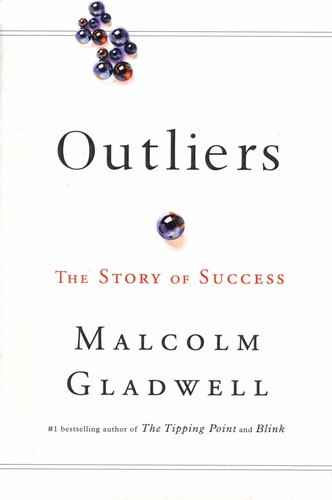
Outliers: The Story of Success
Malcolm Gladwell (2008)
“The book that shattered the myth of the self-made genius by revealing that extraordinary success is less about individual talent and more about hidden advantages, cultural legacies, and the 10,000-hour rule.”
Language Register
Conversational but substantive — Gladwell writes with the accessibility of a magazine journalist and the ambition of a social scientist. The prose is clean, vivid, and paced for sustained engagement. Technical concepts are introduced through stories rather than definitions.
Syntax Profile
Medium-length sentences with strong narrative drive. Gladwell favors the journalistic pattern of surprising opening, specific detail, generalized conclusion. Paragraphs are short by academic standards but longer than newspaper norms. The syntax creates forward momentum — each paragraph builds on the last, leading the reader toward the counterintuitive conclusion.
Figurative Language
Low — Gladwell's prose derives its power from concrete specificity rather than figurative language. When he describes the Hamburg clubs where the Beatles played or the computer room at Lakeside School, the details do the work that metaphors would in more literary prose. The style is reportorial: show, don't tell.
Era-Specific Language
A person or event that lies outside normal experience — in statistics, a data point far from the mean. Gladwell uses it to describe extraordinarily successful individuals.
The claim that mastery of any complex skill requires approximately 10,000 hours of deliberate practice
The principle that initial small advantages accumulate into large ones through compounding opportunity — from the Gospel of Matthew
The social skill of knowing what to say to whom, when, and how — learned from family and class rather than schools
Hofstede's measure of the degree to which subordinates in a culture defer to authority figures
Lareau's term for middle-class parenting that actively develops children's institutional navigation skills
How Characters Speak — Class & Identity
Bill Gates
Described with specific, factual detail about his family's wealth, his school's resources, and the opportunities available to him — not to diminish Gates but to contextualize his achievement
Gladwell's strategy is to praise achievement while exposing its structural prerequisites. Gates is genuinely brilliant AND had access to resources that made his brilliance actionable.
Christopher Langan
Described with empathy and specificity about his poverty, abuse, and lack of institutional navigation skills
Langan is Gladwell's most powerful example of wasted potential — equal intelligence to Gates, without the structural advantages that convert intelligence into achievement.
Korean Air copilots
Described through their communication patterns — the indirection and deference of high-PDI culture
Gladwell uses language patterns as evidence of cultural programming, showing how deeply embedded communication norms affect high-stakes professional performance.
Narrator's Voice
Third-person journalistic with first-person frame in the epilogue. Gladwell positions himself as a guide through counterintuitive terrain — his characteristic rhetorical move is to present a puzzle, develop it through specific examples, and then reveal the unexpected answer. The voice is curious, engaged, and gently provocative.
Tone Progression
Part One: Opportunity
Revelatory, puzzle-solving
Each chapter presents a mystery (why are hockey players born in January?) and solves it through structural analysis. The tone is one of intellectual discovery.
Part Two: Legacy
Cultural, analytical
The tone shifts to more sustained cultural analysis, with longer historical narratives and more complex causal arguments. The puzzle-solving gives way to deeper investigation.
Epilogue
Personal, reflective
Gladwell applies his framework to himself, producing the book's most emotionally resonant and intellectually honest section.
Stylistic Comparisons
- Michael Lewis (Moneyball) — both use narrative nonfiction to reveal hidden structures behind visible outcomes, but Lewis focuses on institutional strategy while Gladwell focuses on individual biography
- Freakonomics (Levitt and Dubner) — similar counterintuitive-revelation structure, but Freakonomics uses economic analysis while Gladwell uses sociological and psychological research
- Charles Duhigg (The Power of Habit) — Duhigg writes in a similar narrative-journalism style and covers related territory (hidden mechanisms behind visible behavior) but focuses on individual behavior rather than structural opportunity