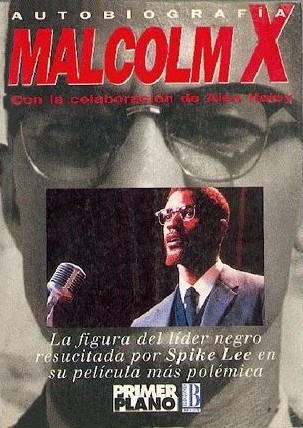
The Autobiography of Malcolm X
Malcolm X and Alex Haley (1965)
“The most radical act of self-invention in American literature — a man who remade himself four times and was killed before he could finish the fifth.”
This page prints on a single page. Use Ctrl+P / Cmd+P.
The Autobiography of Malcolm X
Malcolm X and Alex Haley (1965) · 466pages · Contemporary / Civil Rights Era · 8 AP appearances
Summary
Malcolm Little is born into a family targeted by white supremacists, loses his father to probable murder, watches his mother's mental breakdown, and lands in foster care. He moves to Boston and Harlem, becomes a hustler and drug dealer, and is sentenced to ten years in prison for burglary. In prison he discovers the Nation of Islam and reinvents himself as Malcolm X — the most electrifying Black voice in America. He rises to national prominence as the NOI's chief spokesman, then breaks with Elijah Muhammad after learning of his mentor's hypocrisy. A pilgrimage to Mecca transforms his understanding of race. He returns to found a new movement, and is assassinated before the autobiography is published.
Why It Matters
Published six months after Malcolm's assassination, the autobiography became an immediate bestseller and has sold over ten million copies. It is consistently ranked among the most important nonfiction books of the twentieth century. For the Black Power, Black Arts, and Black Studies movements of ...
Themes & Motifs
Diction & Style
Register: Shifts between vernacular storytelling, formal theological discourse, and political oratory — three distinct registers that correspond to Malcolm's three major identities
Narrator: Dual — Malcolm narrating his own life retrospectively, with Alex Haley's shaping hand always present. Malcolm is simu...
Figurative Language: Moderate but precise
Historical Context
1925-1965: Great Depression, World War II, Great Migration, early Civil Rights Movement, Black Power emergence: The autobiography is written against the grain of the dominant civil rights narrative — Martin Luther King Jr.'s nonviolent integration movement — and its power comes partly from this counter-posit...
Key Characters
Talking Points
- Malcolm reinvents himself four times: as a hustler, a NOI minister, an internationally-minded Muslim, and (emerging) a post-racial universalist. Which transformation is most radical, and what made it possible?
- The autobiography was assembled through interviews with Alex Haley, a journalist who was more politically moderate than Malcolm. How might Haley's presence and editorial decisions have shaped the book we read?
- Malcolm describes his conk (chemically straightened hair) as 'the first really big step toward self-degradation.' Is this retrospective analysis fair to the person who got the conk, or does the older Malcolm judge the younger one too harshly?
- Why does Mr. Ostrowski's comment — 'being a lawyer is no realistic goal for a nigger' — echo through the entire autobiography? What does Malcolm's prison self-education say in response?
- Malcolm argues that the Black informal economy (numbers running, hustling) was a rational response to being excluded from the formal economy. Is this a defense of crime or a structural critique? Both?
Notable Quotes
“I have rarely talked to anyone about my mother, for I believe that I am capable of killing a person, without hesitation, who happened to make the w...”
“It has always been my belief that I, too, will die by violence. I have done all that I can to be prepared.”
“It was then that I began to change — inside. I drew away from white people. I came to class, and I answered when called upon. It became a physical ...”
Why Read This
Because it is the most honest account of what it means to reinvent yourself, written by someone who did it not once but four times — and who knew each transformation was necessary because the previous version of himself could not survive. The auto...