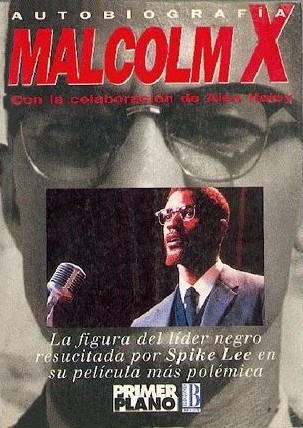
The Autobiography of Malcolm X
Malcolm X and Alex Haley (1965)
“The most radical act of self-invention in American literature — a man who remade himself four times and was killed before he could finish the fifth.”
Essay Questions & Food for Thought
30questions designed to challenge assumptions and provoke original thinking. These can't be answered from a summary — you need the actual text.
Malcolm reinvents himself four times: as a hustler, a NOI minister, an internationally-minded Muslim, and (emerging) a post-racial universalist. Which transformation is most radical, and what made it possible?
The autobiography was assembled through interviews with Alex Haley, a journalist who was more politically moderate than Malcolm. How might Haley's presence and editorial decisions have shaped the book we read?
Malcolm describes his conk (chemically straightened hair) as 'the first really big step toward self-degradation.' Is this retrospective analysis fair to the person who got the conk, or does the older Malcolm judge the younger one too harshly?
Why does Mr. Ostrowski's comment — 'being a lawyer is no realistic goal for a nigger' — echo through the entire autobiography? What does Malcolm's prison self-education say in response?
Malcolm argues that the Black informal economy (numbers running, hustling) was a rational response to being excluded from the formal economy. Is this a defense of crime or a structural critique? Both?
Compare Malcolm X's critique of nonviolent civil rights protest to Martin Luther King Jr.'s 'Letter from Birmingham Jail.' Are they arguing about the same thing, or are they asking different questions?
The Nation of Islam's theology holds that white people are a race of devils created by an evil scientist. Malcolm believes this completely for over a decade. What made a person of Malcolm's intelligence susceptible to a clearly fantastical theology?
After Mecca, Malcolm says he encountered blue-eyed Muslims who had no 'white attitude.' What is he distinguishing between — and is the distinction coherent?
Malcolm's mother Louise Little is described vividly in the early chapters, then disappears into a psychiatric institution and is barely mentioned again. What does this absence do to the autobiography?
'We didn't land on Plymouth Rock. Plymouth Rock landed on us.' What makes this sentence so effective? What does it accomplish rhetorically that a longer argument could not?
Malcolm argues toward the end of his life that the Black American struggle should be brought before the United Nations as a human rights violation rather than addressed through domestic civil rights legislation. Is this a practical strategy or a rhetorical one? Does it matter?
Elijah Muhammad is both the man who gave Malcolm his identity and the man who ordered his death. How does Malcolm hold both truths simultaneously — and how does this shape the autobiography's treatment of belief?
Malcolm calls the house Negro/field Negro distinction the most revealing metaphor for Black American accommodation to white power. Extend this metaphor: who are the house Negroes and field Negroes in contemporary American life?
The autobiography is explicitly collaborative — Malcolm and Haley both shaped it. Does this undermine its authenticity as a first-person testimony, or does it reflect something true about how all identity is constructed through relationship?
Malcolm is described as one of the greatest American orators of the twentieth century. Using specific passages from the autobiography, identify the rhetorical techniques that made his speaking so powerful.
Malcolm writes that he 'saw America through the eyes of a victim.' Is this a limitation of his perspective or the source of its clarity?
Betty Shabazz, Malcolm's wife, is significantly underwritten in the autobiography despite her central role in his life. What does her absence reveal about the autobiography's blindspots?
Malcolm spends the autobiography's final chapters building new organizations even as he receives daily death threats. What does this tell us about his understanding of his own life's purpose?
Compare the autobiography to Frederick Douglass's Narrative of the Life of Frederick Douglass. Both are accounts of self-liberation. What does a century of time between them reveal about what changed — and what didn't?
Malcolm argues that integration is 'a dream for the wrong reasons' — that Black people should build powerful, self-sustaining communities rather than seeking admission to white society. In 2026, does this argument look more or less prescient?
Malcolm writes that he was not a racist — that he never subscribed to racism. Given that he spent a decade teaching that white people were literally devils, is this claim credible? Or is he drawing a distinction between racism and racial analysis?
The autobiography ends before Malcolm can complete his post-Mecca project. Based on the evidence of the final chapters, what would a fully realized 'El-Hajj Malik El-Shabazz' politics have looked like?
Malcolm says prison was the best thing that happened to him. Is this a genuine assessment, a rhetorical move, or a rationalization? What does it reveal about the autobiography's relationship to suffering?
Alex Haley's epilogue describes Malcolm revising manuscript pages in the final weeks of his life, knowing he would not survive to see publication. How does this change your reading of the autobiography as a whole?
James Baldwin and Malcolm X debated publicly and privately about methods and goals. Baldwin believed in the transformative power of love across racial lines; Malcolm believed this was impossible under present conditions. Who was right? Use both men's texts as evidence.
The autobiography has been criticized for its treatment of women — not depicting female characters with the depth it gives to male ones. Is this a failure of Malcolm's vision, a limitation of the era, or a result of Haley's editorial hand?
Malcolm's father was a Garveyite Black nationalist. Malcolm becomes a Black nationalist through the NOI, then moves toward a broader pan-African internationalism. Is this a departure from his father's politics or its most mature expression?
The autobiography appeared in 1965, the same year as the Voting Rights Act. How does the political context of the Civil Rights Act's passage shape what the book argues and what it deliberately leaves out?
Malcolm describes reading the dictionary cover to cover in prison. What does this act — in the context of an incarcerated Black man in 1940s Massachusetts — represent philosophically, not just practically?
If Malcolm X had lived, what would he have made of the internet, social media, and the contemporary information ecosystem? Is 'by any means necessary' a principle that applies to algorithmic organizing?