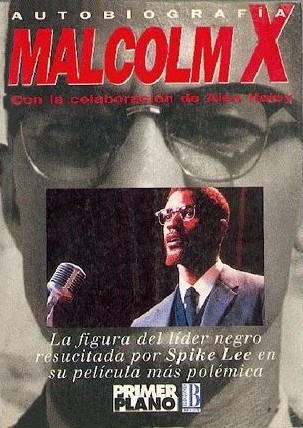
The Autobiography of Malcolm X
Malcolm X and Alex Haley (1965)
“The most radical act of self-invention in American literature — a man who remade himself four times and was killed before he could finish the fifth.”
Language Register
Shifts between vernacular storytelling, formal theological discourse, and political oratory — three distinct registers that correspond to Malcolm's three major identities
Syntax Profile
Three distinct syntactic modes: the vernacular storytelling of childhood and street-life chapters uses short, rhythmic sentences with colloquial phrasing; the NOI chapters use the cadence of Black church oratory — repetition, anaphora, second-person accusation; the post-Mecca chapters become more subordinated, more conditional, reflecting genuine intellectual uncertainty. Alex Haley's editing creates a consistency across all three without erasing their differences.
Figurative Language
Moderate but precise — Malcolm uses metaphor sparingly compared to Fitzgerald but devastatingly. Key figures: the burning house (America as a structure Black people should escape rather than integrate into), the field Negro versus the house Negro, the chickens coming home to roost. Each metaphor is a political argument compressed to an image.
Era-Specific Language
NOI-era shorthand for white American power structures — becomes more qualified in post-Mecca chapters
NOI term rejecting 'Negro' as a slave label while not yet having 'Black' or 'African American'
Malcolm's signature phrase — a refusal to limit Black self-defense to nonviolent methods
Mandatory honorific within NOI — its increasing formality signals Malcolm's growing distance
Not purely pejorative — denotes someone surviving outside legal structures by intelligence and will
How Characters Speak — Class & Identity
Detroit Red (young Malcolm)
Street vernacular, Harlem slang, cadence of the hustler — fast, elliptical, coded
Competence in a parallel economy and social system with its own prestige hierarchy. 'Ignorant' only by the metrics of the dominant culture.
Minister Malcolm X
King James Bible cadence grafted onto Black church oratory — formal, repetitive, accusatory, electrifying
The NOI gave Malcolm the rhetorical tradition of Black religious power. His political analysis runs through that tradition's aesthetic.
El-Hajj Malik El-Shabazz
More measured, subordinated, uncertain — the oratorical certainty softens into something more exploratory
The post-Mecca Malcolm is less interested in winning debates than in getting things right. The shift in rhetoric IS the transformation.
Narrator's Voice
Dual — Malcolm narrating his own life retrospectively, with Alex Haley's shaping hand always present. Malcolm is simultaneously performer, analyst, and subject. He critiques his younger selves with the precision of someone who has been through multiple transformations and knows the signs of a man in need of one.
Tone Progression
Childhood and Harlem chapters
Vivid, urgent, retrospectively furious
The rage has not yet found its political framework. The storytelling is urgent and cinematic.
NOI chapters
Certain, oratorical, missionary
Malcolm has found his framework and believes it completely. The prose mirrors his certainty.
Post-Mecca and final chapters
Reflective, uncertain, prophetic
The certainty cracks open. The prose becomes more exploratory. He is thinking, not pronouncing.
Stylistic Comparisons
- Frederick Douglass's Narrative — the other great American autobiography of self-liberation, written a century earlier under radically different constraints
- Richard Wright's Black Boy — another account of a Black Midwestern childhood and the making of a political consciousness
- James Baldwin's The Fire Next Time — Baldwin and Malcolm debated each other publicly; the books are in permanent conversation about method and tone
Key Vocabulary from This Book
Notable words used in this text — click to see full definitions