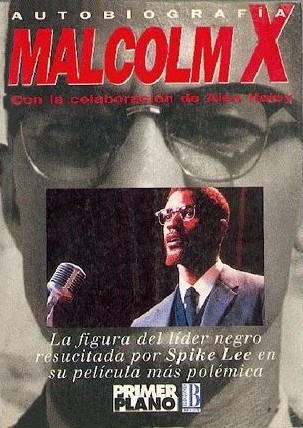
The Autobiography of Malcolm X
Malcolm X and Alex Haley (1965)
“The most radical act of self-invention in American literature — a man who remade himself four times and was killed before he could finish the fifth.”
Why This Book Matters
Published six months after Malcolm's assassination, the autobiography became an immediate bestseller and has sold over ten million copies. It is consistently ranked among the most important nonfiction books of the twentieth century. For the Black Power, Black Arts, and Black Studies movements of the late 1960s, it was the foundational text. It remains one of the most assigned books in American colleges and high schools, and is in continuous print in dozens of languages.
Firsts & Innovations
The first major autobiography to frame Black American life explicitly as a product of systematic white supremacy rather than individual failure or progress
One of the first public American documents to argue that the Black American struggle must be understood as an international human rights issue rather than a domestic civil rights problem
The first major public figure's autobiography to be assembled collaboratively with a journalist and to acknowledge that collaboration openly
Cultural Impact
Foundational text of the Black Power movement — Stokely Carmichael, Huey Newton, and Angela Davis all cite it as formative
Spike Lee's 1992 film adaptation introduced Malcolm X to a new generation; the X baseball cap became a cultural symbol
The phrase 'by any means necessary' passed into the general language as shorthand for radical self-determination
'The house Negro vs. the field Negro' metaphor became one of the most cited frameworks in Black political thought
Required reading in virtually every Black Studies program in the United States; increasingly assigned in high school and AP curricula
Alex Haley went on to write Roots — the autobiography was the beginning of his major career
Banned & Challenged
Challenged and banned in numerous school districts for its critique of white America, its sympathetic treatment of Islam, its depictions of criminal activity, and what critics describe as its 'anti-white' content. The American Library Association consistently lists it among frequently challenged books. The bannings tend to prove Malcolm's argument about institutional resistance to Black self-expression.