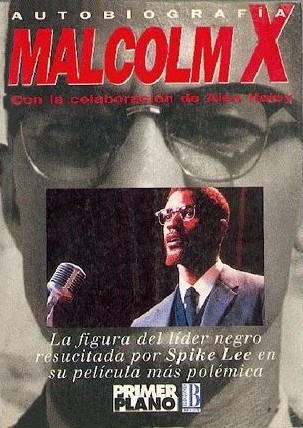
The Autobiography of Malcolm X
Malcolm X and Alex Haley (1965)
“The most radical act of self-invention in American literature — a man who remade himself four times and was killed before he could finish the fifth.”
The Autobiography of Malcolm X— Historical Context & Author Background
Author: Malcolm X and Alex Haley · Published 1965· Era: Contemporary / Civil Rights Era·466 pages
Themes explored: race, transformation, identity, religion, justice, education, power, self-invention
About Malcolm X and Alex Haley
Malcolm Little (1925-1965) was born in Omaha, Nebraska, the son of a Garveyite preacher and a Grenadian mother. His father's death, his mother's institutionalization, his own criminal career, his prison conversion, his rise as the NOI's chief spokesman, his break with Elijah Muhammad, his Hajj pilgrimage, and his assassination at thirty-nine are the autobiography's primary subject. The book was assembled through interviews with journalist Alex Haley, conducted intermittently over two years. Malcolm read and corrected the manuscript during the final weeks of his life, knowing it would be published posthumously. Haley's epilogue documents the collaboration and the assassination.
Life → Text Connections
How Malcolm X and Alex Haley's real experiences shaped specific elements of The Autobiography of Malcolm X.
Malcolm's father Earl Little was a Garveyite — a follower of Marcus Garvey's Black nationalism — and was repeatedly targeted by white supremacist groups
Malcolm's subsequent embrace of Black nationalism is presented not as a radicalization but as a return — to his father's politics, filtered through the Nation of Islam's theology
The ideology that gets Malcolm killed is the same ideology his father died for. The autobiography makes this continuity explicit and tragic.
The eighth-grade counselor who told Malcolm that 'being a lawyer is no realistic goal for a nigger'
The scene recurs across the autobiography as the crystallizing moment that explains Malcolm's relationship to white educational institutions
Malcolm's prison self-education is the autobiography's most direct answer to Mr. Ostrowski. He did, in the end, get the education — just not from the people who were supposed to provide it.
The Hajj pilgrimage to Mecca in 1964, where Malcolm prayed alongside white-skinned Muslims
The post-Mecca chapters and Malcolm's renaming as El-Hajj Malik El-Shabazz
The experience disproves the theological claim of his entire public career — that all white people are devils. Malcolm's willingness to revise publicly, knowing it would cost him allies and possibly his life, is the autobiography's argument about intellectual honesty.
The collaboration with Alex Haley, a Black journalist who was politically closer to the civil rights mainstream than to Black nationalism
The autobiography's occasionally moderate framing and Haley's interventions are visible if you read carefully — particularly in moments where Malcolm's positions are softened or contextualized
The book is not purely Malcolm's voice — it is a collaboration, and Haley's shaping is part of the text. Scholars continue to debate where Malcolm ends and Haley begins.
Historical Era
1925-1965: Great Depression, World War II, Great Migration, early Civil Rights Movement, Black Power emergence
How the Era Shapes the Book
The autobiography is written against the grain of the dominant civil rights narrative — Martin Luther King Jr.'s nonviolent integration movement — and its power comes partly from this counter-position. Malcolm is not ignorant of or opposed to the civil rights movement's goals; he is arguing that those goals do not go far enough and that the methods are psychologically and strategically insufficient. The era's events — Birmingham, Selma, the March on Washington — are present in the autobiography as things Malcolm is watching from a position of radical disagreement.
Why The Autobiography of Malcolm X Matters Historically
Published six months after Malcolm's assassination, the autobiography became an immediate bestseller and has sold over ten million copies. It is consistently ranked among the most important nonfiction books of the twentieth century. For the Black Power, Black Arts, and Black Studies movements of the late 1960s, it was the foundational text. It remains one of the most assigned books in American colleges and high schools, and is in continuous print in dozens of languages.
- The first major autobiography to frame Black American life explicitly as a product of systematic white supremacy rather than individual failure or progress
- One of the first public American documents to argue that the Black American struggle must be understood as an international human rights issue rather than a domestic civil rights problem
- The first major public figure's autobiography to be assembled collaboratively with a journalist and to acknowledge that collaboration openly
Challenged and banned in numerous school districts for its critique of white America, its sympathetic treatment of Islam, its depictions of criminal activity, and what critics describe as its 'anti-white' content. The American Library Association consistently lists it among frequently challenged books. The bannings tend to prove Malcolm's argument about institutional resistance to Black self-expression.