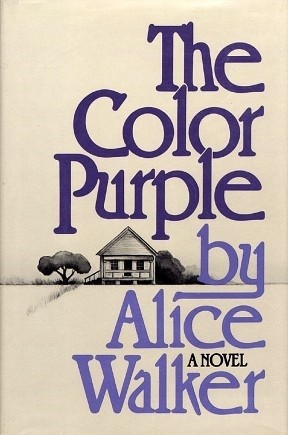
The Color Purple
Alice Walker (1982)
“A Black woman in the Jim Crow South finds her voice, her God, and herself through letters no one was ever supposed to read.”
Essay Questions & Food for Thought
30questions designed to challenge assumptions and provoke original thinking. These can't be answered from a summary — you need the actual text.
Walker writes Celie's letters entirely in AAVE (African American Vernacular English) — dropping copulas, using phonetic spelling, double negatives as intensifiers. Why is this a political as well as a literary decision? What would be lost if Celie's letters were written in standard English?
Celie addresses her first letters to God because 'You better not never tell nobody but God.' By the end, she addresses 'Dear God. Dear stars, dear trees, dear sky, dear peoples. Dear Everything.' How has her conception of God changed — and what does this change say about her transformation?
Shug Avery's first words to Celie are 'You sure is ugly.' By the end of the novel, Shug has called Celie beautiful, written her a song, and been the central agent of her liberation. Is Shug's initial cruelty inconsistent — or does it tell us something about how Shug tests people?
The novel uses two distinct prose registers: Celie's AAVE letters and Nettie's standard English letters. Walker refuses to privilege one over the other. What does this structural choice argue about language, education, and what it means to be 'articulate'?
Sofia hits the mayor back and goes to prison for twelve years. Celie absorbs violence for decades and is never imprisoned. What does Walker say about the different costs of resistance versus compliance for Black women in the Jim Crow South?
Mister has been hiding Nettie's letters for decades. Walker could have revealed this earlier in the novel. Why does she wait until Celie has developed enough of a self for the revelation to transform her — rather than break her?
Celie's pants business — Folkspants, Unlimited — is treated as seriously as any other element of the novel. Why does Walker insist on the economic dimension of Celie's liberation? What would be missing if Celie were liberated emotionally but remained economically dependent?
Walker sets Nettie's narrative in Africa — specifically in the story of a rubber company road destroying an Olinka village. How does this subplot connect to the novel's American story? What is Walker saying by linking them?
Alphonso is eventually revealed not to be Celie's biological father. Does this revelation change how you read his crimes against her? Does it matter — morally or narratively — whether he was her father or her stepfather?
Walker coined the term 'womanist' — distinct from 'feminist' — to describe a Black feminist politics that sees race and gender as inseparable. How does The Color Purple embody 'womanism' rather than mainstream (white) feminism?
Shug leaves Celie for a nineteen-year-old man named Germaine. Many readers find this the novel's most painful section. Why might Walker have included it — what does Celie's grief over Shug add to the novel's argument about transformation?
Walker has cited Zora Neale Hurston's Their Eyes Were Watching God as the direct precursor to The Color Purple. Both novels center Black Southern women's interiority in AAVE. Both were rediscovered (Hurston) or challenged (Walker) after publication. What does this lineage tell you about the reception of Black women's voices in American literature?
Mister transforms in the novel's final third. He makes shirts, learns to do housework, talks with Celie as an equal. Is this transformation believable? What does Walker need us to accept about human change for the ending to work?
The novel is structured as letters — first to God, then between Celie and Nettie. What does the epistolary form argue about the act of writing itself? What does it mean that Celie's survival is enacted through letters?
The novel was banned in multiple school districts for 'negative portrayals of Black men' and for sexual content. Walker responded that the book depicts real conditions that existed. Who gets to decide when a novel's depiction of violence is 'negative portrayal' versus 'accurate record'?
Celie is raped, beaten, separated from her children, robbed of her sister's letters, and denied any education or autonomy — for thirty years. At the novel's end, she is restored to her family and her children. Is this a realistic ending or a wishful one? Does the question matter?
Sofia's speech is the most unhedged in the novel — 'Hell no,' without qualification. Celie's early speech is almost entirely hedged and self-erasing. By the end, Celie's speech is more direct. What does this linguistic convergence tell us about what Celie learns from Sofia?
Compare The Color Purple to Their Eyes Were Watching God. Both center Black Southern women's inner lives in AAVE. Both involve women's relationships to speech and silence. What does Walker add to or change from Hurston's template?
The Celie-Shug relationship is the engine of Celie's transformation. Walker presents it as both romantic and pedagogical — Shug teaches Celie about God, pleasure, self-worth. Is it possible for a relationship to be simultaneously a love story and a liberation narrative? Or does one undercut the other?
Nettie's letters are written in standard English and Celie's in AAVE. But Nettie's letters, however articulate, arrive thirty years late — stolen, hidden, deliberately silenced. What does Walker say about the relationship between formal education and actual power?
'I think it pisses God off if you walk by the color purple in a field somewhere and don't notice it.' — Shug. How does this sentence explain the novel's title? And how does it function as a theory of art?
The novel is set roughly 1910–1940 but was written in 1982. How does the contemporary feminist and Civil Rights context of Walker's writing shape a novel set fifty years earlier? What is Walker writing back to?
Harpo builds larger and larger additions to the house after Sofia leaves — he is eating and building to fill the absence. Walker makes this comic. Why is Harpo treated with comedy when the same emotional pattern (filling absence with obsessive behavior) in Celie's story is treated as tragedy?
The Color Purple ends at a Fourth of July gathering — Independence Day. Is Walker's choice of this day ironic, sincere, or both? What kind of independence is being celebrated?
Walker's own life (rural Georgia, eye injury, sense of ugliness, Civil Rights work, bisexuality) maps directly onto the novel. When a writer draws this closely from autobiography, what are the risks — and what are the benefits?
Corrine dies before she learns the truth about the children. Samuel marries Nettie after. Does Corrine's death feel like a narrative convenience — a way to free Samuel for Nettie — or does Walker earn it? What would have changed if Corrine had lived?
Mister is never named until the novel's final sections, where he becomes 'Albert.' Why does the naming matter? What does it mean to refer to a character by their title (Mister) rather than their name for most of a novel?
Sofia goes to prison and into servitude for hitting a mayor. Alphonso rapes Celie for years and faces no consequences. What does Walker say about whose violence the legal system punishes and whose it protects?
The Spielberg 1985 film adaptation of The Color Purple was nominated for eleven Oscars and won none. Walker's novel won the Pulitzer. A Broadway musical won the Tony. What does it tell you that different art forms have different gatekeeping systems — and that they have rewarded this story differently?
At the novel's close, Celie writes: 'I don't think us feel old at all. [...] Matter of fact, I think this the youngest us ever felt.' Why does transformation feel like youth? What has Celie recovered — and is 'recovery' even the right word for what she's done?