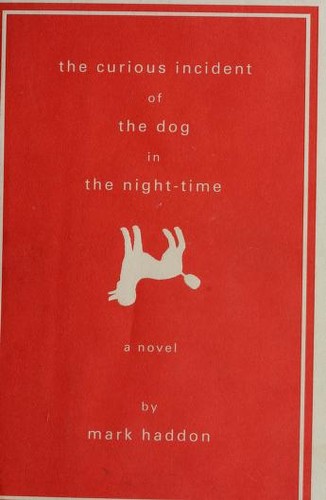
The Curious Incident of the Dog in the Night-Time
Mark Haddon (2003)
“A murder mystery told by a narrator who cannot lie, cannot understand metaphor, and cannot leave his street — until he does.”
This page prints on a single page. Use Ctrl+P / Cmd+P.
The Curious Incident of the Dog in the Night-Time
Mark Haddon (2003) · 226pages · Contemporary / Early 21st Century · 4 AP appearances
Summary
Fifteen-year-old Christopher Boone, who is highly logical and processes the world differently from neurotypical people, discovers his neighbor's dog Wellington has been murdered with a garden fork. Forbidden by his father from investigating, Christopher investigates anyway — and uncovers a far more devastating mystery about his own family. His mother did not die two years ago. She left. The investigation leads Christopher to travel alone from Swindon to London to find her, a journey that represents the most terrifying and triumphant act of his life.
Why It Matters
Curious Incident is one of the most widely read novels in British and American secondary education. It won the Whitbread Novel Award and Whitbread Book of the Year in 2003. It was adapted into a West End and Broadway stage production (2012) that won seven Olivier Awards and five Tony Awards. It f...
Themes & Motifs
Diction & Style
Register: Plain, declarative, highly precise — zero figurative language except in mathematical analogy. Christopher refuses metaphor on principle.
Narrator: Christopher Boone: literal, compulsively honest, highly precise, incapable of metaphor. His voice is the most formall...
Figurative Language: Near zero
Historical Context
Contemporary Britain — early 2000s, post-Thatcher, pre-austerity: The novel arrives precisely at the moment when public consciousness of autism was expanding but before 'neurodiversity' had become a mainstream concept. Haddon's refusal to name Christopher's condi...
Key Characters
Talking Points
- Haddon never names Christopher's condition — the word 'autism' does not appear in the novel. Is this a strength or a weakness of the book? What does naming a condition do, and what does refusing to name it do?
- Christopher cannot lie. How does this make him a more reliable narrator than Nick Carraway or Holden Caulfield — and how does it make him less reliable?
- The chapter numbers are prime numbers. What does this tell you about Christopher before you know anything else about him? What would the novel feel like if the chapters were numbered 1, 2, 3?
- Christopher hates metaphor and will not use it. He also says 'Prime numbers are like life.' Is this a metaphor? What does the exception tell us about his relationship with meaning-making?
- Ed lied to Christopher about Judy's death 'to protect him.' Was Ed wrong? Could Christopher have survived knowing the truth earlier? Use textual evidence.
Notable Quotes
“It was 7 minutes past midnight.”
“I do not like people touching me.”
“I decided to be a detective, like in a book.”
Why Read This
Because it breaks the rules about what a novel is allowed to do — and the rule-breaking is the point. Christopher won't use metaphor. He numbers chapters in primes. He interrupts the plot to prove that there are infinite prime numbers. These aren'...