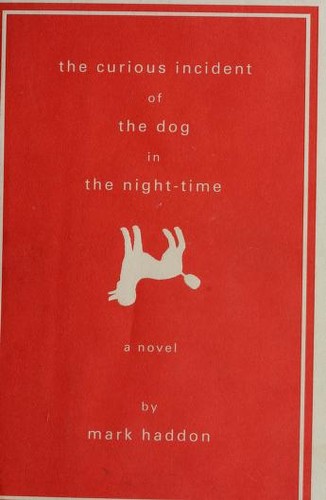
The Curious Incident of the Dog in the Night-Time
Mark Haddon (2003)
“A murder mystery told by a narrator who cannot lie, cannot understand metaphor, and cannot leave his street — until he does.”
Essay Questions & Food for Thought
30questions designed to challenge assumptions and provoke original thinking. These can't be answered from a summary — you need the actual text.
Haddon never names Christopher's condition — the word 'autism' does not appear in the novel. Is this a strength or a weakness of the book? What does naming a condition do, and what does refusing to name it do?
Christopher cannot lie. How does this make him a more reliable narrator than Nick Carraway or Holden Caulfield — and how does it make him less reliable?
The chapter numbers are prime numbers. What does this tell you about Christopher before you know anything else about him? What would the novel feel like if the chapters were numbered 1, 2, 3?
Christopher hates metaphor and will not use it. He also says 'Prime numbers are like life.' Is this a metaphor? What does the exception tell us about his relationship with meaning-making?
Ed lied to Christopher about Judy's death 'to protect him.' Was Ed wrong? Could Christopher have survived knowing the truth earlier? Use textual evidence.
The journey to London takes three chapters. A neurotypical character could describe the same journey in a paragraph. Why does Haddon give the journey so much space, and what would we lose if it were compressed?
Christopher retrieves Toby from the tube tracks at personal risk. What does this tell us about his moral values — and how does it complicate any reading of him as emotionally limited?
Siobhan is the most consistently helpful adult in Christopher's life. Why is it a teacher, not a parent, who occupies this role? What is Haddon suggesting about institutional care versus family care?
The Monty Hall problem chapter interrupts the plot entirely. Why does Haddon include it? How does the mathematics of probability connect to the novel's themes?
Christopher says he does not understand emotions. But he carries his rat across London, he feels 'very frightened' on the tube tracks, he 'liked Wellington.' Is he right that he doesn't understand emotions?
Compare Ed Boone and Tom Buchanan. Both are paternal figures who lie and cause damage. How do their lies differ in motivation, execution, and consequence?
The novel is told entirely from Christopher's point of view, yet we can clearly see that Judy loves him, that Ed is devastated, that Siobhan worries. How does Haddon let us see what Christopher can't?
Christopher says he wants to become a scientist or an astronaut. Given everything we know about how he processes the world, which career would actually suit him better, and why?
The novel includes diagrams, maps, and a mathematics exam question. What do these non-prose elements add to the reading experience? Could the same effect be achieved through description?
Mrs. Alexander tells Christopher about his mother's affair. Should she have? Who, if anyone, had the right to tell Christopher what was happening in his family?
The novel is narrated as a book Christopher is writing. Siobhan reads it as he writes. How does this nested-audience structure (Christopher writing for us but also for Siobhan) affect what he includes and how he includes it?
How would the novel be different if Judy had been the primary parent and Ed the one who left? What does Haddon gain by making the absent parent the mother?
'He had lied to me. He had lied to me about something very important and I didn't know what to do.' This is the most emotionally charged sentence in the novel — yet it contains no emotional vocabulary. How does that work?
Christopher's investigation of Wellington's murder is what we might call 'naive detection' — he gathers evidence without being able to interpret the social context that would guide a trained detective. How does this limitation ultimately help him find the truth?
The novel ends with Christopher saying 'I can do anything.' Is he right? Is this a triumphant ending, a naively optimistic one, or something more complicated?
Compare Christopher's relationship with truth to Holden Caulfield's. Both teenage narrators — one cannot lie, one lies constantly. What does each narrator's relationship with truth reveal about what Salinger and Haddon each think about authenticity?
Haddon worked with autistic people before writing this novel but did not research autism while writing it. He says he was writing Christopher, not 'autism.' Do you think this was the right approach? What are the risks and what are the benefits?
The stage adaptation of Curious Incident won seven Olivier Awards. The production used movement, lighting, and sound design to represent Christopher's sensory experience. What can theatre do with this material that the novel cannot — and vice versa?
Christopher makes decisions based on the color of cars he passes — if he sees four red cars in a row, it's a Good Day. Is this irrational? How is it similar to or different from how neurotypical people make decisions?
The book Christopher is writing — the one we are reading — is discovered by Ed, who confiscates it. Christopher's private thought-record becomes evidence used against him. What does this say about the relationship between writing, privacy, and truth?
Christopher lists the things he knows: all countries of the world, prime numbers up to 7,057, the square roots of most numbers. He does not know how to 'do' grief, or how to comfort someone who is crying. What kind of knowledge does the novel treat as most important?
Roger Shears — the man Judy left for — is a fairly minor character, but his presence causes most of the damage in the novel. Why does Haddon keep him off-stage? What would happen to the novel's moral clarity if he were more fully developed?
Christopher processes the world through sensory data — he is overwhelmed by the London tube in a way that most people are not. How does Haddon make the reader share that experience rather than merely observe it?
The novel is set in Swindon — a post-industrial English town not associated with glamour or aspiration. What does this setting contribute that a London or Oxford setting would not?
If Christopher Boone met Atticus Finch, what would they agree on? What would they find incomprehensible about each other? Use specific evidence from both texts.