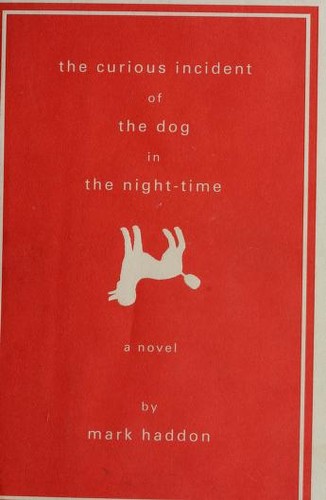
The Curious Incident of the Dog in the Night-Time
Mark Haddon (2003)
“A murder mystery told by a narrator who cannot lie, cannot understand metaphor, and cannot leave his street — until he does.”
For Students
Because it breaks the rules about what a novel is allowed to do — and the rule-breaking is the point. Christopher won't use metaphor. He numbers chapters in primes. He interrupts the plot to prove that there are infinite prime numbers. These aren't quirks; they're arguments about how minds work and how stories are told. If you've ever felt like the world was asking you to perform something you didn't understand, this novel is your book. And at 226 pages with very short chapters, you can finish it in a weekend.
For Teachers
The novel teaches narrative voice, unreliability, and formal experimentation in an unusually concrete way — you can point to a sentence and ask 'What does the absence of figurative language in this sentence tell us?' and students can answer. The mathematical digressions are entry points for cross-curricular discussion. The family story is sophisticated enough for close reading at the AP level. The accessibility of the surface makes the depth available to students who might resist more linguistically dense texts.
Why It Still Matters
Every reader has been in a situation where the social rules felt arbitrary, where someone lied to protect them, where an act of courage was invisible because it didn't look like conventional heroism. Christopher's journey from Swindon to London is one of the great acts of individual courage in contemporary fiction — and it reads as a train timetable. The gap between what happens and how it's reported is the entire novel. That gap is in everything we read.