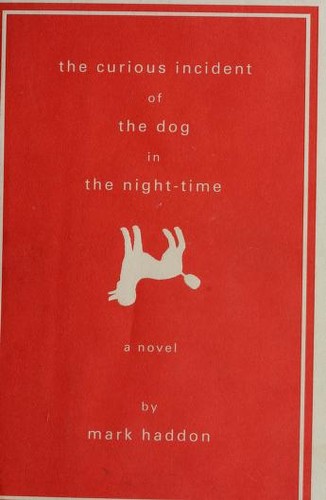
The Curious Incident of the Dog in the Night-Time
Mark Haddon (2003)
“A murder mystery told by a narrator who cannot lie, cannot understand metaphor, and cannot leave his street — until he does.”
Language Register
Plain, declarative, highly precise — zero figurative language except in mathematical analogy. Christopher refuses metaphor on principle.
Syntax Profile
Average sentence length: 8-12 words. No complex subordinate clauses in narration. Connectives are additive ('and,' 'then,' 'because') not concessive ('although,' 'however'). Dialogue is transcribed verbatim with no emotional staging ('she said warmly,' etc.) — every speech tag is 'said' or 'asked.' Christopher does not interpret tone; he records words.
Figurative Language
Near zero — Christopher explicitly states he does not understand metaphor and will not use it. The only figures are mathematical ('prime numbers are like life'). This is not a stylistic preference; it is a cognitive position. The absence of figurative language IS the characterization.
Era-Specific Language
Irish name, phonetically unfamiliar to English readers — Haddon's choice signals the multicultural reality of the British school system
British secondary school qualification at age 18 — equivalent to AP exams in the US context
British term for a school with additional support for students with educational needs — not pejorative in context
Period language for what would now be called neurodivergent traits — Haddon deliberately uses the clinical register of 2003
Christopher's non-verbal response to overwhelm — Haddon describes it behaviorally rather than diagnostically
How Characters Speak — Class & Identity
Christopher
Precise, declarative, literal. No class markers — his language is technically sophisticated (he uses correct terminology for everything) but entirely stripped of social performance.
Class is a social performance Christopher does not participate in. His language reveals intelligence and neurodivergence simultaneously — he sounds neither working-class nor middle-class, just accurate.
Ed (father)
Working-class Swindon register — contractions, direct address, occasional profanity when angry. Speaks more gently than he is angry, more angrily than he intends.
A man managing beyond his emotional capacity. The clipped, direct speech is both working-class and the speech of someone who has learned to communicate with a child who cannot decode nuance.
Judy (mother)
Emotionally expressive, repetitive under stress, sentences that loop and restart. Warmer in register than Ed but less controlled.
Judy communicates through emotion rather than fact — the exact inverse of Christopher. Her warmth is genuine and her emotional incoherence is real. She is not a bad person and not a fully adequate parent.
Siobhan
Clear, patient, deliberate — speaks to Christopher with precision because she has learned he needs precision. No irony, no rhetorical questions, no figures of speech.
Professional care as a linguistic register. Siobhan has adapted her language to Christopher's processing style, which is a form of love rendered as communication technique.
Mrs. Shears
Curt, defensive, unwilling to speak directly to Christopher — her dialogue is notable for what she refuses to say.
Guilt operating as brevity. She knows what Ed did, knows what the affair cost, and cannot look at Christopher because Christopher is the evidence of the harm.
Narrator's Voice
Christopher Boone: literal, compulsively honest, highly precise, incapable of metaphor. His voice is the most formally unusual in contemporary fiction — not because it lacks sophistication but because its sophistication is entirely non-literary. He knows more mathematics than most English professors. He knows fewer narrative conventions than most twelve-year-olds. The collision produces a perspective that is genuinely new.
Tone Progression
Chapters 2–61
Investigative, methodical, curious
Christopher is in control of his project. The detective mode gives structure. The digressions are confident and playful.
Chapters 67–97
Fragmented, recursive, crisis-mode
The letters shatter the narrative's orderliness. Sentence structure breaks. Lists become incomplete. Christopher's syntax reflects cognitive collapse.
Chapters 101–157
Alert, endurance-mode, minimally expressive
The journey requires all resources for navigation. The prose becomes purely functional — sense-data, decisions, coordinates.
Chapters 163–229
Careful, rebuilding, forward-facing
Trust-rebuilding as slow process. Syntax clears. The A-level closing is the most linear prose in the novel — coherence as resolution.
Stylistic Comparisons
- Raymond Carver — similarly stripped, declarative, minimal — but Carver's minimalism is a stylistic choice; Christopher's is a cognitive reality
- Holden Caulfield (Catcher in the Rye) — another teenage narrator who refuses conventional social performance, but where Holden performs contempt, Christopher simply reports
- Nick Carraway (The Great Gatsby) — both unreliable narrators, but Carraway's unreliability is moral; Christopher's is perceptual
Key Vocabulary from This Book
Notable words used in this text — click to see full definitions