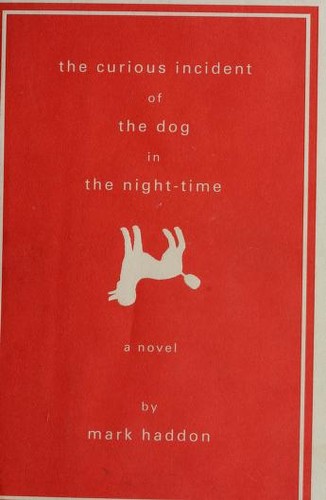
The Curious Incident of the Dog in the Night-Time
Mark Haddon (2003)
“A murder mystery told by a narrator who cannot lie, cannot understand metaphor, and cannot leave his street — until he does.”
The Curious Incident of the Dog in the Night-Time— Historical Context & Author Background
Author: Mark Haddon · Published 2003· Era: Contemporary / Early 21st Century·226 pages
Themes explored: truth, difference, family, independence, perception, logic, courage
About Mark Haddon
Mark Haddon (born 1962, Northampton) worked in his twenties with adults and children with disabilities, including people with autism, before becoming a writer and illustrator of children's books. When he wrote Curious Incident in 2003 — in his early forties — he drew on that direct experience while deliberately declining to label Christopher's condition. Haddon has said in interviews that he did not research autism while writing the novel; he was writing about a specific character who sees the world in a specific way, and he did not want the character to be defined by a diagnosis. This choice was both artistically deliberate and, subsequently, controversial — some advocates in the autistic community criticized the novel's portrayal as a misrepresentation, while others celebrated it. Haddon himself has consistently said Christopher is not 'autistic Christopher' but 'Christopher, who happens to process the world this way.' The novel won the Whitbread Award for both Best Novel and Book of the Year in 2003 and became one of the fastest-selling debut adult novels in British publishing history.
Life → Text Connections
How Mark Haddon's real experiences shaped specific elements of The Curious Incident of the Dog in the Night-Time.
Haddon worked directly with people with autism and other disabilities in his twenties
Christopher's behavioral and cognitive profile is drawn from direct observation rather than research — it has the texture of someone actually known, not a checklist of diagnostic criteria
The difference between a researched portrayal and an observed one is detectable on the page. Christopher feels specific, not representative — which is why the novel works.
Haddon refused to name Christopher's condition and has said the word 'autism' does not appear in the novel
The novel never offers a diagnosis — Christopher refers to his 'behavioral problems' but no specific syndrome is named
The absence of a label is a formal argument: Christopher is a person first, not a condition. Haddon is insisting on individuation against the categorical.
Haddon is a mathematician by training and passion before being a novelist
The mathematical digressions — the Monty Hall problem, the proof of infinite primes, the A-level question — are accurate and substantial, not decorative
A novelist without mathematical knowledge could not have written Christopher's relationship to mathematics. The digressions work because Haddon believes in them.
The novel was published as both an adult novel and a children's/YA novel simultaneously, with different cover designs
Its narrative accessibility (short sentences, simple vocabulary, clear chapter structure) coexists with its thematic complexity (unreliability, family failure, the epistemology of truth)
The dual-audience structure reflects the novel's central insight: Christopher's way of processing the world is simultaneously child-like in method and adult in implication.
Historical Era
Contemporary Britain — early 2000s, post-Thatcher, pre-austerity
How the Era Shapes the Book
The novel arrives precisely at the moment when public consciousness of autism was expanding but before 'neurodiversity' had become a mainstream concept. Haddon's refusal to name Christopher's condition was, in 2003, a more radical gesture than it would be today — most fiction of the time would have either pathologized or sentimentalized. The working-class Swindon setting grounds the story in a social reality of limited resources and modest expectations — Christopher's school is a special school, not a resource-rich private accommodation, and the question of what Christopher's future looks like is practically constrained by economics as well as disability.
Why The Curious Incident of the Dog in the Night-Time Matters Historically
Curious Incident is one of the most widely read novels in British and American secondary education. It won the Whitbread Novel Award and Whitbread Book of the Year in 2003. It was adapted into a West End and Broadway stage production (2012) that won seven Olivier Awards and five Tony Awards. It forced the mainstream literary novel to take the autistic or neurodivergent perspective seriously as a narrative form rather than a subject — Christopher is not a character who has autism; he is a narrator whose cognitive architecture is the novel's form.
- First mainstream literary novel to use a neurodivergent narrator as the formal basis of the prose style, not merely its subject
- First novel to embed actual A-level Mathematics examination questions as narrative content
- One of the first dual-audience novels (simultaneous adult and YA publication) to be taken equally seriously in both markets
Challenged in some American school districts for language (Christopher swears periodically, the incidents involving police contain mild profanity) and for family content (parental infidelity, parental deception). Some autistic advocacy groups have criticized its classroom use as potentially misleading about autistic experience.