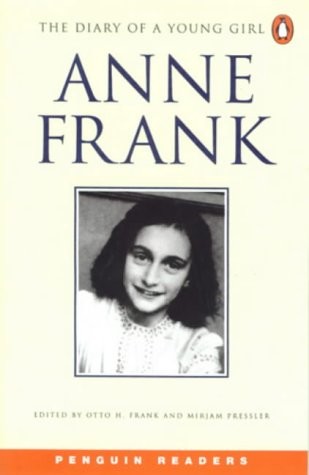
The Diary of a Young Girl
Anne Frank (1947)
“A thirteen-year-old girl hiding from the Nazis wrote the most read diary in human history — and never knew it.”
The Diary of a Young Girl— Historical Context & Author Background
Author: Anne Frank · Published 1947· Era: Contemporary / WWII·283 pages
Themes explored: survival, hope, identity, coming-of-age, family, war, humanity, witness
About Anne Frank
Annelies Marie Frank (1929-1945) was born in Frankfurt, Germany, to Otto and Edith Frank. The family fled to Amsterdam in 1933 when Hitler came to power. Anne grew up in Amsterdam, attending Montessori school and developing a reputation as talkative, socially magnetic, and intellectually restless. On her thirteenth birthday she received the diary. Less than a month later, the family went into hiding. Anne spent two years and one month in the Secret Annex. After the raid, she was transported through Westerbork transit camp to Auschwitz-Birkenau. She survived the selection and was not immediately sent to the gas chambers. In October 1944, as the Soviets advanced on Auschwitz, she and Margot were transferred to Bergen-Belsen in Germany. Both sisters died there, likely of typhus, in late February or early March 1945. Bergen-Belsen was liberated by British forces on April 15, 1945. Anne Frank was fifteen years old when she died.
Life → Text Connections
How Anne Frank's real experiences shaped specific elements of The Diary of a Young Girl.
Anne was educated at the Montessori school in Amsterdam and was known as an exceptionally social and verbal child
The diary's earliest entries — fast, social, chatty, full of names and gossip — reflect exactly this personality. The voice is recognizably the voice of a child who has been praised for talking.
Anne's verbal gifts were recognized and cultivated before the diary. The diary is not a surprise — it is a continuation of a personality that was already literary.
The Franks were secular, assimilated, German-speaking Jews who considered themselves Dutch
Anne's relationship to Jewish identity in the diary is ambivalent and evolving — she does not start from a place of strong religious identity but develops one under pressure
The diary documents not just physical survival but the formation of a Jewish identity under conditions designed to make that identity a death sentence.
Otto Frank was a businessman who maintained relationships across religious and national lines — his helpers were all non-Jewish Dutch citizens
The helpers appear throughout the diary as models of human decency — Anne's belief that 'people are good at heart' is not abstract. It is based on specific evidence: Miep Gies, Bep Voskuijl, Jan Gies.
The diary's famous optimism is not naive — it is grounded in the actual behavior of actual people who chose courage over compliance.
Anne heard a radio broadcast by the Dutch minister Bolkestein urging Dutch citizens to preserve their wartime diaries for a future archive
She began a conscious revision of the diary — the B version — with publication in mind. The published diary is partly Anne's own literary act.
Anne Frank knew she wanted to publish the diary. She made editorial decisions. The diary is not an accidental document — it is, in part, a consciously constructed one.
Historical Era
World War II, Nazi occupation of the Netherlands (1940-1945)
How the Era Shapes the Book
The diary is the Holocaust's most intimate document — one consciousness, in real time, experiencing Nazi persecution not as history but as daily life. The progressive narrowing of Jewish freedom before 1942 is visible in Anne's early entries: the restrictions accumulate without drama, normalized into the texture of ordinary adolescence. The deportations, the fear, the guilt of being hidden while others are taken — these are not background to the diary. They are its moral atmosphere. Anne's philosophical optimism is not a response to peacetime inconvenience. It is a response to genocide.
Why The Diary of a Young Girl Matters Historically
Het Achterhuis was published in a print run of 1,500 copies in 1947. It has since sold more than 35 million copies and been translated into more than 70 languages — making it one of the most widely read books in human history. It is the most direct, intimate, and widely distributed account of what it felt like to be Jewish in Nazi-occupied Europe. For millions of readers, Anne Frank is the Holocaust — which is both the diary's extraordinary power and its most serious interpretive problem.
- The first Holocaust memoir to achieve mass readership — published before most survivor accounts
- One of the first texts to make a Jewish child the protagonist and full human subject of a Nazi-era narrative
- A foundational work of witness literature — helped establish the genre that includes Night, Maus, and Survival in Auschwitz
- The first work to make the daily texture of hiding — the rules, the boredom, the minute-by-minute fear — fully visible to an outside audience
The diary has been challenged and banned in numerous school districts in the United States, primarily for two reasons: the restored passages in the Definitive Edition (2001) that discuss Anne's sexuality and her curiosity about female anatomy, and the passages expressing doubt about the existence of God. In 2022, a school board in Tennessee temporarily removed it. The Definitive Edition, which restores Otto Frank's omissions, is the most frequently challenged version.