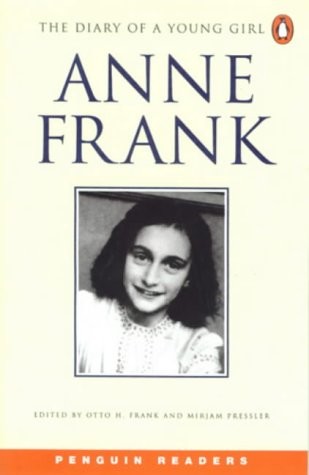
The Diary of a Young Girl
Anne Frank (1947)
“A thirteen-year-old girl hiding from the Nazis wrote the most read diary in human history — and never knew it.”
Language Register
Informal in the early entries — chatty, quick, unguarded. Progressively more formal and philosophically deliberate as the diary continues. The final entries read as conscious literary prose.
Syntax Profile
Anne's sentences evolve across two years from short, quick, exclamatory clauses to long, subordinated philosophical constructions. She has a characteristic move: assertion, then immediate qualification ('but I must say...', 'on the other hand...', 'yet I know...'). This self-correcting syntax is the grammatical expression of an honest mind. Her humor arrives in parenthetical asides and sudden tonal pivots — a sentence of genuine despair followed by a comic observation delivered without warning.
Figurative Language
Moderate and growing. The early entries are nearly figurative-free — straightforward, journalistic, concrete. By 1944, Anne is using consistent metaphors, particularly around light and darkness, cages and freedom, surfaces and depths (the 'two Annes'). The figurative language deepens as the philosophical thinking deepens.
Era-Specific Language
Anne's name for her imaginary diary-friend — the device that turns a private journal into an epistolary performance
Het Achterhuis in Dutch — literally 'the house behind.' Not Anne's term; added by publishers. Anne called it the 'Secret Annex' in her revision.
Dutch for raid — the word used for Nazi sweeps through Jewish neighborhoods
Miep Gies, Bep Voskuijl, Jan Gies, Johannes Kleiman, Victor Kugler — the office employees who risked their lives supplying the Annex
National Socialist Movement — Dutch Nazi collaborators; Anne uses the term as a general curse for collaborators
How Characters Speak — Class & Identity
Anne Frank
Educated, secular, middle-class German-Dutch assimilated Jewish family. Anne's language is multilingual — she thinks in German, writes in Dutch, studies English and French. Her references are literary and cultured. She writes about Goethe, Dickens, mythology, history.
The Franks were thoroughly assimilated into Dutch bourgeois culture — which made their persecution not merely unjust but personally disorienting. They thought of themselves as Dutch first. The Nazis disagreed.
Otto Frank
Formal, measured, diplomatic. Anne's descriptions of her father emphasize his patience and precision. He reasons with her rather than commanding her. His class position — educated, professional, multilingual — is visible in his approach to crisis: organized, strategic, careful.
Otto Frank prepared the hiding place methodically, cultivated helpers, and managed the Annex with an authority that was gentle rather than coercive. His class gave him resources — the office building, the network — that made survival possible at all.
Edith Frank
More traditional, more religious than Otto. Anne's portrayal of her mother's speech is rarely quoted, which is itself revealing — Edith Frank is largely voiceless in a diary that gives everyone else a distinct verbal personality. What Anne records of her mother is attitude, not language.
Edith Frank came from a more observant Jewish background than Otto. The assimilated and the traditional were compressed together in the Annex, and the friction was partly generational and partly cultural. Anne's difficulty with her mother was not only adolescent rebellion — it was a daughter pushing against a different relationship to Jewish identity.
Auguste van Pels (Mrs. van Pels)
Theatrical, acquisitive, class-anxious. Anne's portraits of Auguste van Pels are the diary's sharpest satire. She argues loudly about possessions, competes with Edith Frank for status, and deploys a social performance that Anne finds exhausting and transparent.
The van Pels family came from a slightly different social stratum — Hermann van Pels was a butcher and spice trader. Auguste's social performance reveals the Annex's class dynamics: even in hiding, people are marking status and managing appearances.
Peter van Pels
Quiet, working-class in sensibility, limited formal education. Anne initially finds him inarticulate and dull. As she comes to know him, she distinguishes between his inability to express himself verbally and his inner life, which she finds richer than his words suggest.
Peter's reticence is partly temperamental and partly class — he has not been schooled in the self-expression that Anne's education cultivated. The romance is, among other things, a negotiation between two different relationships to language and interiority.
Fritz Pfeffer (Mr. Dussel)
Pedantic, proprietary, formal in a way that slides into pomposity. Anne's portrait of Pfeffer is the diary's least charitable sustained characterization — she finds him condescending and entitled.
Pfeffer was a dentist, professional-class, accustomed to being the expert in the room. The Annex strips him of his professional context without stripping him of his professional manner. Anne's irritation with him is partly the irritation of youth with pomposity, and partly genuine: he lectures without listening, which is a real failing in a confined space.
Narrator's Voice
Anne Frank is both narrator and subject, both the person writing and the person being examined. She maintains a peculiar dual consciousness throughout — she is aware of being a writer, aware of the diary as an artifact, aware of herself as a character in her own story. This self-consciousness is what elevates the diary from personal record to literature. Anne Frank is not simply recording her experience — she is making sense of it, and the making-sense is visible on every page.
Tone Progression
June–October 1942
Chatty, energetic, girlish — interrupted by terror
The voice of a popular teenager who is also, suddenly, in hiding. The tonal whiplash is part of the document's power.
November 1942 – August 1943
Irritable, self-critical, increasingly interior
Confinement has worn the social surface thinner. Anne is angrier, more honest, more willing to examine her own failures.
September 1943 – January 1944
Romantic, vulnerable, exploratory
The Peter relationship opens a softer register. The armor drops. The longing becomes specific.
February – August 1944
Philosophical, luminous, urgent
The final months are the diary's literary peak. Anne is writing for posterity and she knows it. The voice achieves a quality that belongs to no particular age.
Stylistic Comparisons
- Zlata's Diary by Zlata Filipović — another child's diary of wartime siege (Sarajevo, 1991-93), explicitly modeled on Anne Frank's
- Night by Elie Wiesel — the Holocaust's other foundational witness text, written by a survivor in retrospect, with none of Anne's real-time uncertainty
- The Complete Persepolis by Marjane Satrapi — a coming-of-age narrative under political oppression, similarly combining the personal and political, with Anne Frank's same wry self-awareness
Key Vocabulary from This Book
Notable words used in this text — click to see full definitions