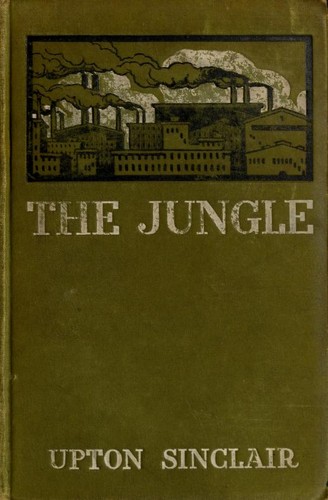
The Jungle
Upton Sinclair (1906)
“The novel that aimed at America's heart and hit its stomach — a muckraking masterpiece that changed federal law and exposed the human cost of industrial capitalism.”
This page prints on a single page. Use Ctrl+P / Cmd+P.
The Jungle
Upton Sinclair (1906) · 413pages · Early Modern / Progressive Era · 3 AP appearances
Summary
Jurgis Rudkus, a young Lithuanian immigrant, arrives in Chicago's Packingtown with his family, believing in the American Dream. He finds work in the meatpacking plants, where the conditions are so brutal and the system so rigged that his family is systematically destroyed — through wage theft, unsafe labor, sexual exploitation, disease, and death. After losing his wife Ona, his son, his home, and his dignity, Jurgis drifts through crime and homelessness before discovering socialism at a political rally. The novel ends with Jurgis converted to the socialist cause, but the reader remembers the slaughterhouse.
Why It Matters
The Jungle is one of the rare novels that directly changed federal law. Within months of publication, Theodore Roosevelt ordered an investigation of the meatpacking industry. The resulting Neill-Reynolds Report confirmed Sinclair's findings, and Congress passed both the Pure Food and Drug Act and...
Themes & Motifs
Diction & Style
Register: Middle register — journalistic precision in the meatpacking sections, rising to oratorical formality in the socialist chapters, dropping to stark simplicity in scenes of suffering
Narrator: Third-person omniscient with strong authorial intrusion. Sinclair's narrator is not neutral — he editorializes, conde...
Figurative Language: Moderate
Historical Context
1900s America — Progressive Era, peak immigration, industrialization, labor unrest: The Jungle exists at the intersection of three massive historical forces: the Great Wave of immigration that brought 20 million Europeans to America between 1880 and 1920, the industrialization tha...
Key Characters
Talking Points
- Sinclair said 'I aimed at the public's heart, and by accident I hit it in the stomach.' What does this reveal about the relationship between authorial intention and reader response — and does the novel's actual impact (food safety law) validate or undermine Sinclair's purpose?
- Jurgis's refrain 'I will work harder' echoes throughout the early chapters. How does Sinclair construct this phrase so that its destruction carries maximum emotional and political weight?
- The novel opens with a wedding feast and ends with a political rally. How do these framing scenes define the arc of the novel — from what to what?
- Phil Connor's assault on Ona is presented not as the act of a uniquely evil man but as a structural feature of unchecked employer power. How does Sinclair's framing change the moral argument compared to a conventional villain narrative?
- Sinclair spent seven weeks living undercover in Packingtown before writing the novel. How does this investigative method shape the prose — and what are the literary consequences of writing fiction from journalistic research?
Notable Quotes
“I will work harder!”
“They were beaten; they had lost the game, they were swept aside... They had dreamed of freedom; of a chance to look about them and learn something;...”
“There was never the least attention paid to what was cut up for sausage... There would be meat stored in great piles in rooms; and the water from l...”
Why Read This
Because the food you eat today is safer because of this book. The Jungle is one of the few novels that changed the law — not through argument but through description. Sinclair shows you what unregulated capitalism looks like at the level of the hu...