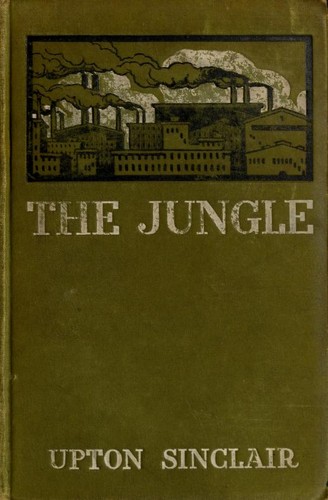
The Jungle
Upton Sinclair (1906)
“The novel that aimed at America's heart and hit its stomach — a muckraking masterpiece that changed federal law and exposed the human cost of industrial capitalism.”
The Jungle— Historical Context & Author Background
Author: Upton Sinclair · Published 1906· Era: Early Modern / Progressive Era·413 pages
Themes explored: capitalism, immigration, labor, corruption, meatpacking, socialism, american-dream, exploitation
About Upton Sinclair
Upton Sinclair (1878-1968) was a lifelong socialist who wrote nearly one hundred books but is remembered primarily for one. Born in Baltimore to an impoverished alcoholic father and a puritanical mother, Sinclair put himself through college by writing pulp fiction. In 1904, the socialist newspaper Appeal to Reason commissioned him to write a novel about the meatpacking industry. Sinclair spent seven weeks living among the workers of Packingtown, investigating conditions firsthand. The resulting novel was rejected by five publishers before Doubleday accepted it. The Jungle made Sinclair famous and changed American law — but not in the way he intended. He ran for governor of California in 1934 on the EPIC (End Poverty in California) platform and nearly won. He continued writing and agitating for socialism until his death at ninety.
Life → Text Connections
How Upton Sinclair's real experiences shaped specific elements of The Jungle.
Sinclair spent seven weeks undercover in Chicago's Packingtown, interviewing workers, observing conditions, and taking notes
The meatpacking descriptions that constitute the novel's most powerful sections — the diseased meat, the chemical preservatives, the rats in the sausage
The Jungle's power derives from eyewitness specificity. Sinclair did not imagine the stockyard horrors — he documented them. The novel functions as testimony.
Sinclair was a committed socialist who intended the novel as a political argument, not an exposé of food safety
The socialist conversion chapters that close the novel — Jurgis's awakening, the extended political speeches, the rally cry
The gap between authorial intention and public reception is the novel's central irony. Sinclair aimed at the heart (socialism) and hit the stomach (food safety).
Five publishers rejected the manuscript before Doubleday accepted it — partly because the meatpacking industry threatened legal action
The novel's unflinching specificity about named companies and documented practices
The publishing history demonstrates that the economic powers the novel critiques had the ability to suppress criticism — validating the novel's argument about concentrated corporate power.
Sinclair ran for governor of California in 1934 and nearly won, showing the political movement he championed had real electoral support
The novel's ending, with socialist election gains and the cry 'Chicago will be ours!'
The electoral optimism of the final chapter was not fantasy — socialist candidates were winning elections in the Progressive Era, and Sinclair himself nearly captured a governorship.
Historical Era
1900s America — Progressive Era, peak immigration, industrialization, labor unrest
How the Era Shapes the Book
The Jungle exists at the intersection of three massive historical forces: the Great Wave of immigration that brought 20 million Europeans to America between 1880 and 1920, the industrialization that created the factory system they entered, and the Progressive reform movement that sought to address the resulting exploitation. Chicago's Packingtown was the most concentrated expression of all three forces — a place where immigrant labor, industrial capitalism, and political corruption converged in a single neighborhood. Sinclair's genius was to make one Lithuanian family's experience represent the experience of millions.
Why The Jungle Matters Historically
The Jungle is one of the rare novels that directly changed federal law. Within months of publication, Theodore Roosevelt ordered an investigation of the meatpacking industry. The resulting Neill-Reynolds Report confirmed Sinclair's findings, and Congress passed both the Pure Food and Drug Act and the Meat Inspection Act in 1906. The novel did not achieve Sinclair's goal of advancing socialism, but it created the foundation for federal food safety regulation that persists to this day. It remains the defining example of muckraking literature's capacity to translate fiction into policy.
- One of the first novels to directly produce federal legislation — the Pure Food and Drug Act of 1906
- Pioneered the technique of sustained literary muckraking — using fiction as investigative journalism
- One of the first American novels to center immigrant experience as its primary subject
- Established the template for the 'novel of social protest' that influenced Steinbeck, Wright, and others
Challenged and banned repeatedly for graphic content — the meatpacking descriptions, sexual content (Ona's assault), and socialist politics have all provoked censorship attempts. Banned in Yugoslavia, East Germany, and South Korea at various times. Challenged in American schools for 'promoting socialism' and for graphic violence. The irony: the content that gets it banned is the content that makes it essential.