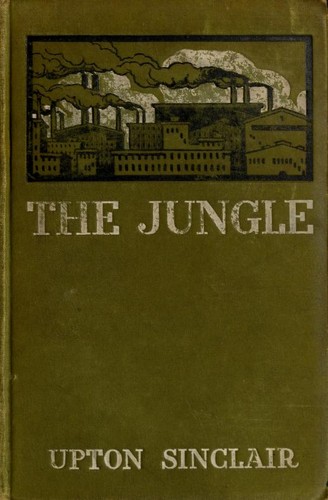
The Jungle
Upton Sinclair (1906)
“The novel that aimed at America's heart and hit its stomach — a muckraking masterpiece that changed federal law and exposed the human cost of industrial capitalism.”
Essay Questions & Food for Thought
30questions designed to challenge assumptions and provoke original thinking. These can't be answered from a summary — you need the actual text.
Sinclair said 'I aimed at the public's heart, and by accident I hit it in the stomach.' What does this reveal about the relationship between authorial intention and reader response — and does the novel's actual impact (food safety law) validate or undermine Sinclair's purpose?
Jurgis's refrain 'I will work harder' echoes throughout the early chapters. How does Sinclair construct this phrase so that its destruction carries maximum emotional and political weight?
The novel opens with a wedding feast and ends with a political rally. How do these framing scenes define the arc of the novel — from what to what?
Phil Connor's assault on Ona is presented not as the act of a uniquely evil man but as a structural feature of unchecked employer power. How does Sinclair's framing change the moral argument compared to a conventional villain narrative?
Sinclair spent seven weeks living undercover in Packingtown before writing the novel. How does this investigative method shape the prose — and what are the literary consequences of writing fiction from journalistic research?
The meatpacking plant is described as a machine that makes no distinction between the cattle and the workers. Trace this metaphor through the novel. Where does Sinclair draw the parallel most explicitly, and where is it most effective?
Marija Berczynskas begins as the family's strongest member and ends as a morphine-addicted prostitute. What argument is Sinclair making about the relationship between individual strength and systemic power?
The novel's treatment of Black strikebreakers has been criticized as racist. How does this racial blind spot complicate Sinclair's socialist argument about class solidarity?
Compare the house the family buys on installment to modern predatory lending (subprime mortgages, payday loans). Has the mechanism of exploitation changed, or just the vocabulary?
Teta Elzbieta survives everything — Ona's death, Antamas's drowning, eviction, poverty. Sinclair gives her no dramatic conversion, no rebellion. Why? What is he saying about endurance versus resistance?
The Jungle directly produced two federal laws (Pure Food and Drug Act, Meat Inspection Act). Can you name another novel that changed legislation? What does it mean when fiction has more political impact than nonfiction journalism?
Jurgis's son Antamas drowns in a mud puddle in an unpaved street. Why does Sinclair choose this specific, banal cause of death rather than a dramatic stockyard accident?
The socialist conversion in the final chapters is often called the novel's weakest section. Do you agree? Is there a way to read the ending as structurally necessary rather than artistically failed?
Compare The Jungle to Eric Schlosser's Fast Food Nation (2001). Both expose the food industry; one is fiction, one is journalism. Which is more effective at provoking change, and why?
Sinclair describes the political machine — vote fixing, patronage, corruption — with sardonic humor rather than outrage. Why does the tone shift matter? How does comedy function differently from tragedy as a tool of social criticism?
Replace Packingtown with an Amazon fulfillment center. Replace Lithuanian immigrants with gig economy workers. How much of Sinclair's critique still applies in 2026?
The novel's naturalism treats characters as products of environment and heredity rather than free moral agents. Does this deterministic framework strengthen or weaken Sinclair's political argument?
Sinclair renders the Lithuanian family's dialogue in formal, slightly stilted English. What is the effect of this translation strategy? How does it convey both dignity and vulnerability?
Jack Duane tells Jurgis that crime pays better than honest labor. Is Sinclair arguing that crime is rational under capitalism? If so, what does that imply about the system?
The meatpacking plant converts living creatures into commodities through a series of mechanical operations. How does Sinclair extend this metaphor to describe what Packingtown does to the immigrant family?
Theodore Roosevelt read The Jungle and was moved to action — but only on food safety, not on labor rights. Why did the consumer protection argument succeed where the worker protection argument failed?
Compare Jurgis Rudkus to Jay Gatsby. Both believe in the American Dream; both are destroyed by it. How does class position (immigrant worker versus self-made millionaire) change the shape of the destruction?
Ona's silence after Connor's assault — her retreat into lies and broken speech — is described through the absence of language rather than through direct narration. Why does Sinclair choose this technique?
The novel was commissioned by the socialist newspaper Appeal to Reason. How does knowing the novel was written to order — with a specific political agenda — change your assessment of it as literature?
Sinclair's prose style shifts dramatically across the novel: documentary in the meatpacking chapters, anguished in the family tragedy, sardonic in the political machine, oratorical in the socialist conversion. Is this inconsistency a flaw or a strategy?
The children in the novel — pulled from school, sent to work in the stockyards, denied childhood — are Sinclair's most politically effective characters. Why are child laborers more persuasive to readers than adult laborers?
Compare The Jungle to The Grapes of Wrath. Both follow a family destroyed by economic forces, both end with collective hope. How does the thirty-year gap between them (1906 vs. 1939) change the argument?
The novel uses the phrase 'they use everything about the hog except the squeal' as Packingtown's motto. How does this phrase function as both industrial boast and moral indictment?
Sinclair chose to write a novel rather than a journalistic exposé. Given that his investigative research was rigorous enough to prompt federal investigation, why fiction? What can a novel do that a report cannot?
If Sinclair were writing The Jungle today, what industry would he choose? What community would his protagonist belong to? Write the opening paragraph of a 2026 version.