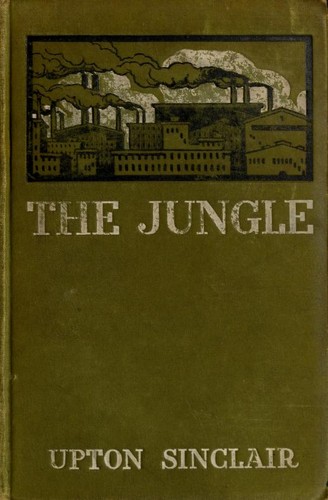
The Jungle
Upton Sinclair (1906)
“The novel that aimed at America's heart and hit its stomach — a muckraking masterpiece that changed federal law and exposed the human cost of industrial capitalism.”
Language Register
Middle register — journalistic precision in the meatpacking sections, rising to oratorical formality in the socialist chapters, dropping to stark simplicity in scenes of suffering
Syntax Profile
Long compound sentences in the meatpacking descriptions, mimicking the assembly line — each clause feeds into the next without pause. Short declarative sentences in moments of suffering and violence. Extended, periodic sentences in the socialist chapters, building to rhetorical climaxes. Sinclair's default sentence length is above average, reflecting the naturalist tradition of exhaustive documentation.
Figurative Language
Moderate — Sinclair relies more on factual accumulation than metaphor. The central metaphor (workers as cattle being processed) is structural rather than decorative. Similes are rare; when they appear, they tend to be blunt comparisons between human and animal conditions.
Era-Specific Language
The neighborhood surrounding Chicago's Union Stock Yards — a company town where every institution serves the meatpackers
Management practice of increasing assembly line speed to extract more labor from the same workforce
Strikebreaker — worker who crosses a picket line, often recruited from other cities or racial groups
Political boss controlling a city district through patronage, favors, and intimidation
Journalist or novelist who exposes corruption — term coined by Theodore Roosevelt, partly in response to Sinclair
How Characters Speak — Class & Identity
Jurgis Rudkus
Simple, direct, physical. His speech is translated from Lithuanian and rendered as plain English. His language contracts as his hope diminishes — fewer words, shorter sentences.
The immigrant worker reduced to his body. Jurgis's shrinking vocabulary mirrors his shrinking autonomy.
Ona Lukoszaite
Quiet, broken, elliptical — especially after Connor's assault. Her speech fragments into silence.
The silencing of women under capitalism. Ona's loss of language is her loss of selfhood.
Phil Connor
Blunt commands, threats. His language is entirely transactional — power exercised through speech.
The foreman class speaks in imperatives because the system has given them the power to command.
The Socialist Orator
Elevated, rhythmic, rhetorical. Long periodic sentences building to crescendos. Biblical cadences.
Sinclair frames socialism as America's new gospel — the language of political awakening borrows the register of religious revival.
Mike Scully
Colloquial, shrewd, backslapping. The language of the saloon and the ward office.
Political power in Packingtown operates through false intimacy — the boss speaks as friend while exploiting as master.
Narrator's Voice
Third-person omniscient with strong authorial intrusion. Sinclair's narrator is not neutral — he editorializes, condemns, and lectures. The voice oscillates between journalistic precision (the meatpacking chapters), emotional anguish (the family tragedy chapters), and political rhetoric (the socialist chapters). The narrator's refusal to maintain objective distance is itself a political stance: neutrality in the face of exploitation is complicity.
Tone Progression
Chapters 1-4
Cautiously hopeful, documentary
The family arrives with hope. Sinclair lets the reader invest in their dream before dismantling it.
Chapters 5-12
Increasingly despairing, forensic
The system grinds the family down. Prose becomes clinical as suffering becomes routine.
Chapters 13-16
Devastating, stripped
Death upon death. Language contracts to its barest elements.
Chapters 17-24
Sardonic, expansive
Crime, politics, strikes. The canvas widens and the prose adopts satirical detachment.
Chapters 25-31
Didactic, oratorical, urgent
Rock bottom to conversion. Prose swells into political rhetoric and sermonic cadence.
Stylistic Comparisons
- Émile Zola — Germinal's coal miners are Packingtown's slaughterhouse workers; both novels use naturalist documentation to build socialist arguments
- Frank Norris — The Octopus covers the same Progressive Era terrain with similar naturalist technique but less political commitment
- Jacob Riis — How the Other Half Lives applies the same muckraking method to tenement conditions, but as journalism rather than fiction
- John Steinbeck — The Grapes of Wrath inherits The Jungle's structure: immigrant family destroyed by economic system, ending in collective hope
Key Vocabulary from This Book
Notable words used in this text — click to see full definitions