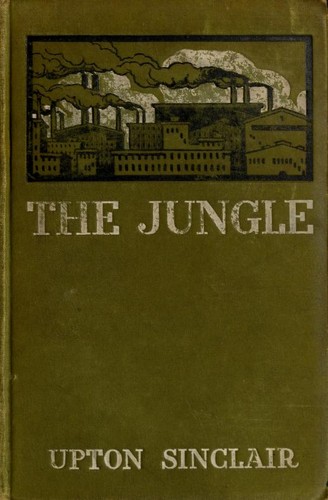
The Jungle
Upton Sinclair (1906)
“The novel that aimed at America's heart and hit its stomach — a muckraking masterpiece that changed federal law and exposed the human cost of industrial capitalism.”
The Jungle— Summary & Analysis
by Upton Sinclair · published 1906 · 413 pages · Early Modern / Progressive Era
A user-friendly study guide for The Jungle by Upton Sinclair (1906): a high-level plot summary, full chapter-by-chapter analysis, theme breakdowns, character profiles, and 30 essay questions designed for high-school, ap-english, college readers. Unlike a stock summary, sumsumsum.com adds a diction analysis drawn from Upton Sinclair’s actual text, the 3 documented AP Literature exam appearances of this book, and reading-difficulty guidance (Easy, 3/10) so students, teachers, and lifelong readers know what they are walking into.
“The novel that aimed at America's heart and hit its stomach — a muckraking masterpiece that changed federal law and exposed the human cost of industrial capitalism.”
Short Summary
Jurgis Rudkus, a young Lithuanian immigrant, arrives in Chicago's Packingtown with his family, believing in the American Dream. He finds work in the meatpacking plants, where the conditions are so brutal and the system so rigged that his family is systematically destroyed — through wage theft, unsafe labor, sexual exploitation, disease, and death. After losing his wife Ona, his son, his home, and his dignity, Jurgis drifts through crime and homelessness before discovering socialism at a political rally. The novel ends with Jurgis converted to the socialist cause, but the reader remembers the slaughterhouse.
Detailed Summary
Jurgis Rudkus and his extended Lithuanian family arrive in Chicago around 1900, drawn by promises of opportunity in the stockyards. The family includes his young wife Ona Lukoszaite, her stepmother Teta Elzbieta, Ona's cousin Marija Berczynskas, and a constellation of children and elderly dependents...
Summary in the Author’s Writing Style
A retelling of The Jungle in Upton Sinclair’s style — so you can hear the language, not just the plot. This is a stylistic pastiche written by sumsumsum, not an excerpt from the book.
They came out of Lithuania with their hands full of nothing but the strength of their bodies, Jurgis Rudkus and Ona Lukoszaite and the old folk and the children, and they crossed an ocean and half a continent to stand at last in the smoke of Packingtown, where the sky was the color of cured meat and…
Chapter-by-Chapter Analysis
If you liked The Jungle, read next
Start with The Grapes of Wrath by John Steinbeck — The Jungle's spiritual successor — another family destroyed by economic forces, another ending that insists on collective hope over individual defeat. Then try Germinal by Émile Zola — The French naturalist masterwork about coal miners — same technique of documentary immersion, same naturalist determinism, same socialist conclusion. Or pivot to How the Other Half Lives by Jacob Riis — The muckraking predecessor — photojournalism exposing tenement conditions in New York, the nonfiction blueprint for Sinclair's fictional method.