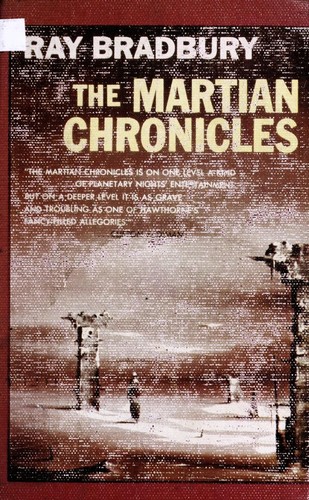
The Martian Chronicles
Ray Bradbury (1950)
“A book about Mars that is really about Earth -- written by a man who never learned to drive, distrusted machines, and saw the American frontier myth for the beautiful lie it always was.”
This page prints on a single page. Use Ctrl+P / Cmd+P.
The Martian Chronicles
Ray Bradbury (1950) · 222pages · Postmodern / Cold War · 3 AP appearances
Summary
Between 1999 and 2026, humans launch expeditions to Mars, colonize it, strip it of its ancient civilization, import their petty Earth culture, then abandon it when nuclear war breaks out back home. The few who remain become the new Martians. Bradbury uses twenty-eight linked stories to replay the colonization of America -- this time on red soil, and this time with full knowledge of what colonization destroys.
Why It Matters
The Martian Chronicles proved that science fiction could be literature -- that genre fiction could address colonialism, nuclear anxiety, censorship, and the human condition with the same seriousness and beauty as any 'literary' novel. Published in 1950, it was immediately recognized as something ...
Themes & Motifs
Diction & Style
Register: Mid-register with frequent poetic elevation -- Midwestern plainness punctuated by passages of almost incantatory lyricism
Narrator: Third-person omniscient, shifting between stories but maintaining a consistent tone: elegiac, wondering, faintly mour...
Figurative Language: Very high -- Bradbury is among the most metaphor-dense prose writers in English. His metaphors are typically drawn from nature and domestic life rather than from technology or abstraction: rockets bloom like flowers, cities are described as hives or cathedrals, silence has texture and weight. He almost never uses technical language, even when describing machines.
Historical Context
1945-1950 America -- early Cold War, nuclear anxiety, postwar expansion, McCarthyism: The Martian Chronicles is a product of the brief, terrifying period between the first atomic bombs and the full institutionalization of Cold War culture. Bradbury wrote it when nuclear annihilation...
Key Characters
Talking Points
- Bradbury called The Martian Chronicles a book about 'how we would ruin another world the way we have ruined our own.' Is this the only way to read the collection, or does the ending offer genuine hope for human transformation?
- Why does Bradbury structure the book as linked short stories rather than a continuous novel? How does the 'fix-up' structure affect the reader's experience of colonization as a process?
- The Third Expedition is killed by telepathic Martians who construct a replica of the crew's hometown. What does this story say about nostalgia as a psychological vulnerability?
- In 'There Will Come Soft Rains,' there are no human characters. Why is this the collection's most emotionally devastating story? What does the absence of humans accomplish that their presence could not?
- Compare the colonization of Mars in Bradbury's collection to the historical colonization of the Americas. Where does the parallel hold, and where does it break down?
Notable Quotes
“They looked at the old hometown with the eyes of people who had been away a long time and had returned.”
“Is this not enough? Do you want me to be ill? Do you want me to be committed?”
“They knew how to live with nature and get along with nature. They didn't try to nail anything down or burn anything up.”
Why Read This
Because it is the most beautiful book ever written about the worst things humans do -- colonize, destroy, forget, and repeat. Each story is short enough to read in twenty minutes and dense enough to discuss for an hour. The prose will teach you mo...