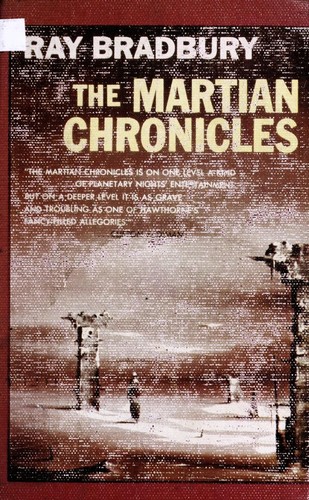
The Martian Chronicles
Ray Bradbury (1950)
“A book about Mars that is really about Earth -- written by a man who never learned to drive, distrusted machines, and saw the American frontier myth for the beautiful lie it always was.”
The Martian Chronicles— Essay Questions & Discussion Prompts
Essay Questions & Food for Thought
30questions designed to challenge assumptions and provoke original thinking. These can't be answered from a summary — you need the actual text.
Bradbury called The Martian Chronicles a book about 'how we would ruin another world the way we have ruined our own.' Is this the only way to read the collection, or does the ending offer genuine hope for human transformation?
Why does Bradbury structure the book as linked short stories rather than a continuous novel? How does the 'fix-up' structure affect the reader's experience of colonization as a process?
The Third Expedition is killed by telepathic Martians who construct a replica of the crew's hometown. What does this story say about nostalgia as a psychological vulnerability?
In 'There Will Come Soft Rains,' there are no human characters. Why is this the collection's most emotionally devastating story? What does the absence of humans accomplish that their presence could not?
Compare the colonization of Mars in Bradbury's collection to the historical colonization of the Americas. Where does the parallel hold, and where does it break down?
Spender kills his crewmates to prevent the colonization of Mars. Is he a hero, a villain, or something the collection refuses to categorize? Does Bradbury want you to agree with him?
The automated house in 'There Will Come Soft Rains' is described as 'an altar with ten thousand attendants' whose 'gods had gone away.' What is Bradbury saying about the relationship between technology and worship?
In 'The Martian,' a shape-shifting alien becomes whatever each human most desires and is torn apart by competing needs. What is Bradbury saying about the nature of human desire?
Bradbury never learned to drive, distrusted computers, and considered himself a fantasy writer, not a science fiction writer. How does this biographical context change your reading of his anti-technology themes?
In 'Night Meeting,' Tomas and Muhe Ca each see the other as a ghost. Neither can prove the other wrong. Is Bradbury suggesting that colonizer and colonized occupy genuinely different realities?
The settlers abandon Mars the moment Earth is in danger, leaving their entire colonial infrastructure behind. What does the speed of this abandonment reveal about the nature of their attachment to Mars?
Bradbury wrote 'Usher II' three years before Fahrenheit 451. How does reading the two together change your understanding of his views on censorship?
The Martians in the collection are telepathic, shape-shifting, and culturally integrated with their environment. Why does Bradbury make the colonized civilization superior to the colonizing one?
Hathaway builds robot replicas of his dead family. How does this story complicate Bradbury's anti-technology stance? Is the creation of the robots an act of love or an act of denial?
How would The Martian Chronicles read differently if published today, in the context of actual Mars exploration (rovers, planned missions)? Does real Mars diminish or enhance Bradbury's imagined Mars?
The father in 'The Million-Year Picnic' burns his family's Earth documents. Is this a liberation or a denial? Can you start a new civilization by destroying the records of the old one?
Sara Teasdale's poem 'There Will Come Soft Rains' describes nature's indifference to human extinction. Why does Bradbury have a machine read this poem to an empty room? What layers of irony are at work?
Compare Bradbury's treatment of colonialism in The Martian Chronicles to Chinua Achebe's in Things Fall Apart. Both depict the destruction of an indigenous civilization. How do their approaches differ?
Bradbury's Mars has been called 'the Midwest with red sand.' What does it mean that his alien planet looks like Illinois? Is this a failure of imagination or a deliberate artistic choice?
The collection spans 1999 to 2026 -- dates that were the future when Bradbury wrote in 1950 but are now the past and near-present. How does reading the book after its timeline has 'expired' affect its meaning?
Why does Bradbury never fully describe Martian culture from the Martians' own perspective? We see them through human eyes, in human encounters. What is the effect of this narrative limitation?
The settlers rename Martian landmarks after themselves. How does the act of naming function as colonization? Can you think of modern examples of the same process?
Captain Wilder is the collection's moral center -- decent, reflective, and powerless. What is Bradbury saying about the role of individual morality within systemic destruction?
Bradbury wrote during the era of McCarthyism and HUAC. How do the censorship themes in 'Usher II' reflect the specific political anxieties of 1950 America?
The fix-up novel structure means different stories have different tones, styles, and even contradictory details. Is this a flaw or a feature? How does inconsistency serve the collection's themes?
Compare Bradbury's automated house in 'There Will Come Soft Rains' to modern smart home technology (Alexa, Google Home, automated routines). Has Bradbury's warning been heeded or fulfilled?
In 'Way in the Middle of the Air,' the entire Black population of a Southern town leaves for Mars. The white townspeople are outraged. What is Bradbury saying about who colonization serves and who it threatens?
Bradbury described himself as a writer of 'myths and metaphors' rather than science fiction. Based on The Martian Chronicles, is this a more accurate label? What does calling the book 'myth' rather than 'SF' change about how you read it?
The collection begins with human arrival on Mars and ends with humans becoming the new Martians. Is this a circle or a transformation? Has anything changed between the first page and the last?
Read the final paragraph of 'The Million-Year Picnic' aloud. How does the sound and rhythm of Bradbury's closing sentences create meaning beyond the literal words? What does the prose DO that plot summary cannot capture?