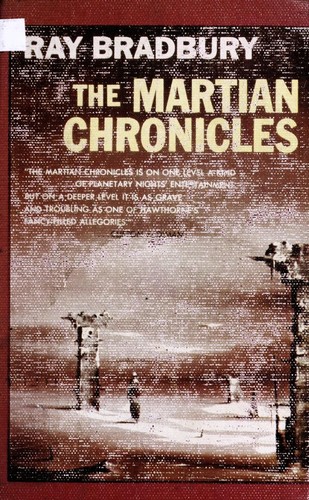
The Martian Chronicles
Ray Bradbury (1950)
“A book about Mars that is really about Earth -- written by a man who never learned to drive, distrusted machines, and saw the American frontier myth for the beautiful lie it always was.”
Why This Book Matters
The Martian Chronicles proved that science fiction could be literature -- that genre fiction could address colonialism, nuclear anxiety, censorship, and the human condition with the same seriousness and beauty as any 'literary' novel. Published in 1950, it was immediately recognized as something different from the pulp SF of its era. Christopher Isherwood reviewed it as a work of art, not a genre exercise. It became the book that English teachers could assign without apologizing for the genre label, and it opened the door for science fiction to be taken seriously in academic contexts.
Firsts & Innovations
One of the first science fiction works accepted as serious literature by the mainstream critical establishment
Pioneered the 'fix-up novel' structure -- linked short stories creating a unified narrative arc -- that influenced works from Asimov's Foundation to Mitchell's Cloud Atlas
One of the first American works to use science fiction explicitly as colonial allegory, predating postcolonial readings of SF by decades
Cultural Impact
Made Ray Bradbury a household name and the most publicly visible science fiction writer in America for fifty years
Directly influenced Fahrenheit 451 -- 'Usher II' is essentially a trial run for the novel's central premise
Adapted for television (1980 miniseries), radio, stage, and opera -- one of the most frequently adapted SF works
The phrase 'Martian chronicles' entered common usage as shorthand for ambitious, poetic science fiction
Influenced generations of writers including Neil Gaiman, Margaret Atwood, and Octavia Butler, all of whom cited Bradbury as formative
Banned & Challenged
Challenged in schools primarily for its depiction of book burning (ironically), its treatment of religion, and its racial content in 'Way in the Middle of the Air.' Bradbury himself was furious about censorship of his work and wrote extensively about the irony of banning a book that warns against banning books.