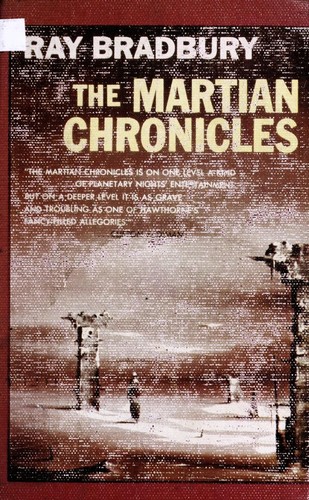
The Martian Chronicles
Ray Bradbury (1950)
“A book about Mars that is really about Earth -- written by a man who never learned to drive, distrusted machines, and saw the American frontier myth for the beautiful lie it always was.”
Language Register
Mid-register with frequent poetic elevation -- Midwestern plainness punctuated by passages of almost incantatory lyricism
Syntax Profile
Bradbury's sentences are short by literary fiction standards -- averaging 12-15 words -- but arranged in rhythmic sequences that create a cumulative, almost hypnotic effect. He favors parallel construction (X did this, Y did that, Z did the other) and builds paragraphs through accretion rather than subordination. The effect is closer to poetry or oral storytelling than to novelistic prose.
Figurative Language
Very high -- Bradbury is among the most metaphor-dense prose writers in English. His metaphors are typically drawn from nature and domestic life rather than from technology or abstraction: rockets bloom like flowers, cities are described as hives or cathedrals, silence has texture and weight. He almost never uses technical language, even when describing machines.
Era-Specific Language
Not technical hardware but mythic conveyance -- Bradbury's rockets are more covered wagon than spacecraft
The Martian canals drawn from Percival Lowell's debunked 1890s Mars observations -- already nostalgic when Bradbury wrote them
The defining anxiety of 1950 -- nuclear annihilation as background radiation for every story
Bradbury's term for the isolated settlers -- loneliness elevated to a proper noun, a category of being
The quintessential symbol of Bradbury's small-town America, transplanted to Mars -- domesticity as the only framework humans have for processing the alien
How Characters Speak — Class & Identity
The Settlers (collective)
Plain American English -- contractions, colloquialisms, the vocabulary of small-town commerce and domestic routine
The colonizers are ordinary people, not scientists or soldiers. Their ordinariness is the point: colonialism is not enacted by exceptional individuals but by average people transplanting average lives.
Spender
Elevated, formal, occasionally archaic -- the register of someone who has read widely and is consciously choosing words as weapons
Spender is the collection's intellectual conscience, and his language marks him as separate from the other crew members. His eloquence isolates him as much as his convictions do.
Captain Wilder
Measured, moderate, the language of command tempered by reflection -- neither as plain as the settlers nor as elevated as Spender
Wilder is the liberal center -- thoughtful, decent, and ultimately powerless. His moderate language reflects his moderate position: he sees the problem but cannot act decisively.
The Martians
When Martians speak, their language is formal, musical, and slightly archaic -- Bradbury gives them the diction of a civilization that has had time to refine every utterance
The Martians' linguistic elegance contrasts with human plainness, reinforcing the collection's hierarchy of civilizational achievement. The colonized are more articulate than the colonizers.
Narrator's Voice
Third-person omniscient, shifting between stories but maintaining a consistent tone: elegiac, wondering, faintly mournful. Bradbury's narrator is not a character but a sensibility -- someone who loves the world being described and knows it is doomed. The voice is closest to a poet watching a landscape burn.
Tone Progression
Early Expeditions (1999-2000)
Eerie, darkly comic, fairy-tale
The failed expeditions have the rhythm of folklore -- three attempts, each more unsettling. The horror is intimate and domestic, not cosmic.
Colonization (2001-2005)
Satirical, elegiac, increasingly angry
As Mars is colonized, Bradbury's prose alternates between lyrical mourning for Martian culture and acid satire of human banality. The tone darkens steadily.
Destruction and Aftermath (2005-2026)
Devastated, quiet, mythic
The final stories are Bradbury's most restrained and most powerful. The prose is stripped bare. The tone is that of someone delivering a eulogy for a species.
Stylistic Comparisons
- Hemingway -- similar sentence brevity but opposite emotional temperature: Bradbury's short sentences are warm where Hemingway's are cold
- Faulkner -- shares the elegiac quality and the mourning for a vanished civilization, but Bradbury is far more accessible
- Steinbeck -- closest American prose relative: both write about ordinary people with extraordinary tenderness and embed social critique in domestic detail
- No comparison within science fiction -- Bradbury's prose style is unique in the genre, closer to the literary mainstream than to any SF contemporary
Key Vocabulary from This Book
Notable words used in this text — click to see full definitions