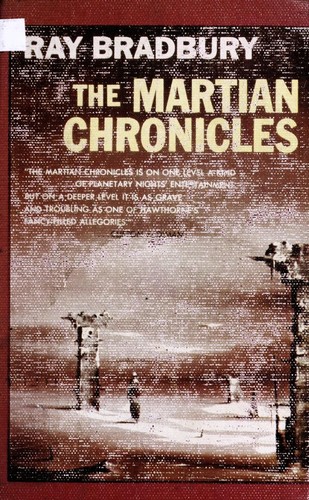
The Martian Chronicles
Ray Bradbury (1950)
“A book about Mars that is really about Earth -- written by a man who never learned to drive, distrusted machines, and saw the American frontier myth for the beautiful lie it always was.”
The Martian Chronicles— Summary & Analysis
by Ray Bradbury · published 1950 · 222 pages · Postmodern / Cold War
A user-friendly study guide for The Martian Chronicles by Ray Bradbury (1950): a high-level plot summary, full chapter-by-chapter analysis, theme breakdowns, character profiles, and 30 essay questions designed for high-school, ap-english, college readers. Unlike a stock summary, sumsumsum.com adds a diction analysis drawn from Ray Bradbury’s actual text, the 3 documented AP Literature exam appearances of this book, and reading-difficulty guidance (Easy, 3/10) so students, teachers, and lifelong readers know what they are walking into.
“A book about Mars that is really about Earth -- written by a man who never learned to drive, distrusted machines, and saw the American frontier myth for the beautiful lie it always was.”
Short Summary
Between 1999 and 2026, humans launch expeditions to Mars, colonize it, strip it of its ancient civilization, import their petty Earth culture, then abandon it when nuclear war breaks out back home. The few who remain become the new Martians. Bradbury uses twenty-eight linked stories to replay the colonization of America -- this time on red soil, and this time with full knowledge of what colonization destroys.
Detailed Summary
The Martian Chronicles is not a novel in any conventional sense. It is a 'fix-up' -- twenty-eight stories and interstitial vignettes, written independently between 1945 and 1950, then arranged chronologically to span the years 1999 through 2026. The result is a mosaic rather than a narrative arc, an...
Summary in the Author’s Writing Style
A retelling of The Martian Chronicles in Ray Bradbury’s style — so you can hear the language, not just the plot. This is a stylistic pastiche written by sumsumsum, not an excerpt from the book.
In the winter of that first year the rockets came, and they bloomed against the cold sky like brief red flowers, and the towns of Ohio and the towns of Iowa looked up and saw the summer of fire passing over, and the snow melted from the porches, and the people put away their woolen things, and the r…
Chapter-by-Chapter Analysis
If you liked The Martian Chronicles, read next
Start with The Left Hand of Darkness by Ursula K. Le Guin — Another SF novel where the alien encounter is really about human limitations -- Le Guin's anthropological lens complements Bradbury's poetic one. Then try Slaughterhouse-Five by Kurt Vonnegut — Another postwar American novel processing mass destruction through science fiction -- Vonnegut's Tralfamadore and Bradbury's Mars serve similar allegorical functions. Or pivot to The Dispossessed by Ursula K. Le Guin — Colonization and utopian possibility on another world -- Le Guin asks whether the new civilization Bradbury's ending hopes for is actually achievable.
For comparative essays, pair The Martian Chronicles with
The strongest comparative pairing is Things Fall Apart (Chinua Achebe) — The colonization story told from the other side -- Achebe gives voice to the civilization that Bradbury's Martians never fully receive.
Each of these pairings opens a clean thesis path on shared themes, period diction, or formal influence — useful for AP Lit / IB / first-year college comparative essays.
More from Ray Bradbury and the scholars who study Bradbury
Other works by Ray Bradbury: Fahrenheit 451 (1953, 158 pages), Something Wicked This Way Comes (1962, 293 pages). Reading two or three of these in sequence reveals Ray Bradbury’s recurring obsessions and stylistic signatures more clearly than any single book can.