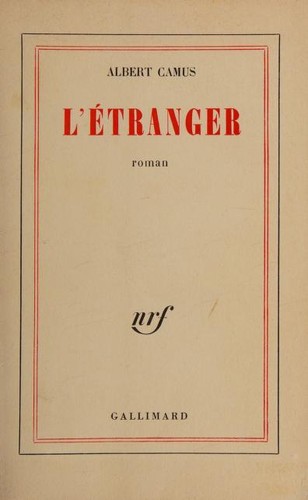
The Stranger
Albert Camus (1942)
“A man kills someone he barely knows, feels nothing, and goes to the guillotine refusing to pretend otherwise — and somehow becomes the most honest person in the room.”
The Stranger— Historical Context & Author Background
Author: Albert Camus · Published 1942· Era: Modernist / Absurdist·123 pages
Themes explored: absurdity, alienation, death, truth, morality, freedom, indifference
About Albert Camus
Albert Camus (1913-1960) was born in Mondovi, French Algeria, to a working-class family. His father was killed in the Battle of the Marne in 1914; his mother, illiterate and partially deaf, worked as a cleaning woman. They lived in a two-room apartment in the working-class Belcourt neighborhood of Algiers with Camus's grandmother and uncle. His schoolteacher Louis Germain recognized his intelligence and fought to have him attend secondary school despite his family's poverty — a debt Camus acknowledged in his Nobel Prize speech. He won a scholarship to study philosophy at the University of Algiers, where he was also a goalkeeper for the local football team, before tuberculosis ended his athletic career and prevented him from taking the agrégation examination. He worked as a journalist, theater director, and playwright in Algiers before moving to Paris during World War Two. He completed The Stranger in 1940 and published it in 1942. He broke with Jean-Paul Sartre in the early 1950s — a philosophical and personal rupture that defined postwar French intellectual life — over Camus's refusal to excuse Soviet labor camps in the name of revolutionary solidarity. He won the Nobel Prize in Literature in 1957, three years before his death in a car accident at 46.
Life → Text Connections
How Albert Camus's real experiences shaped specific elements of The Stranger.
Camus grew up in Algiers in genuine poverty, in a working-class neighborhood where French colonists and Arab Algerians lived in close but unequal proximity
Meursault's social world — the apartment building, the beach, the neighborhood with Raymond and Salamano — is drawn from Camus's own Belcourt. The physical world of the novel is the physical world Camus grew up in.
The novel's sensory precision — the heat, the sea, the light — is autobiographical memory, not literary invention. Camus knew these streets, this sun, this social world.
Camus was a French Algerian (pied-noir) who was ambivalent about French colonial rule — he never advocated full independence for Algeria but was critical of the violence of colonial suppression
The Arab man Meursault kills has no name, no speech, no family shown grieving. His death is treated as legally and socially minor. This is the colonial order rendered honestly and, critics argue, without adequate critique.
The Arab's namelessness reflects the actual status of Arab Algerians under French colonial law — legally subordinate, socially invisible. Whether Camus was critiquing this or reproducing it is the novel's central unresolved political debate.
Camus developed his philosophy of the absurd in the same period as writing The Stranger — The Myth of Sisyphus was published the same year (1942)
Meursault IS the absurd man before he understands it. His behavior in Part One is the absurdist position lived unreflectively. His speech to the chaplain in Part Two is the absurdist position argued passionately.
The novel and the essay are companion texts. The Stranger shows the philosophy; The Myth of Sisyphus argues for it. Meursault is Sisyphus — condemned to repeat meaningless action, finding happiness anyway.
Camus's break with Sartre centered on the question of bad faith — Sartre's existentialism argued that refusing to choose is itself a choice that implicates you in the system's crimes; Camus's absurdism argued that clarity without rebellion is still clarity
Meursault refuses bad faith before either man has named it. He cannot pretend to feel what he doesn't feel. Whether this is heroism or moral failure is the question both philosophers debated.
Reading The Stranger through the Camus-Sartre debate transforms Meursault from a local character into the site of a philosophical argument that shaped the twentieth century.
Historical Era
French Algeria, 1940s — colonial occupation, World War Two, the beginning of the Algerian independence movement
How the Era Shapes the Book
The Stranger is set in French Algeria as though colonialism were simply background — the Arab man who dies has no name, no family shown, no social context. This was the naturalized colonial worldview Camus grew up in. Whether the novel critiques that naturalization (by showing how invisible Arab death is to European law) or reproduces it (by failing to give the Arab a perspective) is the central debate in Stranger scholarship since decolonization. The Arab-Algerian writer Kamel Daoud answered The Stranger directly in his 2013 novel The Meursault Investigation, which retells the story from the murdered Arab's brother's perspective and names him: Musa.
Why The Stranger Matters Historically
Published in Nazi-occupied France in 1942, The Stranger was immediately recognized as something new: a prose style that enacted its philosophy rather than merely arguing it. Camus was 28. The book became the ur-text of postwar existentialism (despite Camus's later rejection of the label) and has sold more than 10 million copies in France alone. It is the most widely read French-language novel globally.
- Introduced the 'zero degree of writing' — a prose style stripped to the absolute minimum that became the most imitated mode of the twentieth century
- First major European novel to place colonial violence at its center while narrating from inside the colonial perspective without critique — creating a text that requires its reader to supply the moral framework
- One of the first novels to dramatize the absurdist philosophical position rather than argue it — Meursault IS the Myth of Sisyphus, not an illustration of it
Challenged in schools for moral nihilism, for the narrator's lack of remorse, and for its perceived attack on religion and God. Banned or restricted in some Catholic schools and institutions in the 1950s. In postcolonial scholarship, regularly critiqued for its representation (or erasure) of Arab Algerians — assigned alongside Daoud's response novel in many contemporary courses.