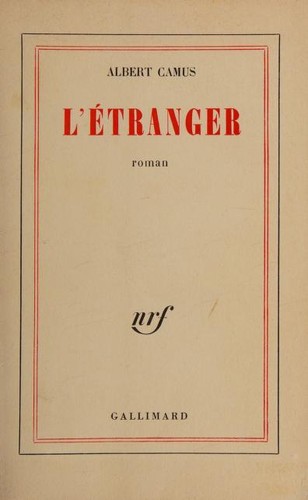
The Stranger
Albert Camus (1942)
“A man kills someone he barely knows, feels nothing, and goes to the guillotine refusing to pretend otherwise — and somehow becomes the most honest person in the room.”
Language Register
Deceptively simple — short declarative sentences, direct vocabulary, almost no metaphor or simile. Conceals philosophical depth behind surface transparency.
Syntax Profile
Short declarative sentences averaging 8-12 words. Passé composé tense throughout (compound past) creates a sense of witnessed, catalogued events rather than lived experience. No embedded relative clauses in the French — English translations must approximate this. Parataxis (listing without subordination) is the dominant structural mode: 'I did X. Then I did Y. Then Z happened.'
Figurative Language
Extremely low — the novel is almost free of metaphor and simile. The rare figurative moments are physical and sensory, not abstract. The sun 'cutting' across Meursault's forehead is the most sustained metaphorical passage. Camus's refusal of figurative language is the style's argument: the world resists meaning, and the prose refuses to impose any.
Era-Specific Language
French Algerian colonial settler — Meursault's identity, never named in the text but embedded in the setting
French legal system figure who investigates before trial — has significant power over framing the case
French term for mother — more childlike than 'mère,' signals intimacy that complicates the charge of coldness
The colonial quarter of Algiers — Meursault's social world, where European colonists lived adjacent to Arab population
Hot desert wind off the Sahara — part of the environmental pressure Meursault describes
How Characters Speak — Class & Identity
Meursault
Flat, affectless, paratactic. No social performance in his language — no formulas of politeness, no register-shifting for authority figures. Same tone with his boss, his lover, the magistrate, the chaplain.
Lower-middle class French colonial whose education gave him vocabulary but not social ambition. His refusal to code-switch to authority registers is both his authenticity and his fatal flaw in court.
Marie Cardona
Direct, warm, practical. Her speech is slightly more idiomatic and emotionally expressive than Meursault's — she says 'I love you,' she asks about the future. She belongs to the same class as Meursault but performs social expectations he ignores.
A woman who knows the social scripts and chooses to follow them. Her relationship with Meursault is partly attracted by his refusal to perform — and partly terrified by what that refusal means.
Raymond Sintès
Rough, idiomatic, aggressive. Working-class speech with the confidence of someone who's used physical intimidation as social currency. More elaborate in his self-justifications than Meursault.
Raymond performs masculinity through speech as much as violence. His elaborate story about the Arab mistress is self-serving narration. He's the novel's closest thing to a conventional liar.
The Arab (unnamed)
No speech. His dialogue is his body — the knife, the presence, the dying. He is the novel's most radical erasure.
The Arab's namelessness is Camus's most disturbing colonial blind spot — and the text's most honest political statement. The trial ignores the Arab. The novel nearly does too. His silencing is a character decision and a political one simultaneously.
The Examining Magistrate
Formal, procedural speech that breaks down into religious fervor. Code-switches from legal register to evangelical register. His professional authority depends on Meursault performing guilt.
Authority requires audience participation. The magistrate's certainty is only certainty if others confirm it. Meursault's refusal to perform threatens the magistrate's entire worldview.
The Prison Chaplain
Measured, gentle, increasingly desperate as Meursault refuses. Uses 'my son' and 'brother' — the language of spiritual kinship. Becomes agitated when the framework fails.
Religious language as a system requiring consent. The chaplain's framework only functions if Meursault accepts its premises. His escalation from gentle to forceful is the system's response to a subject who won't participate.
Narrator's Voice
Meursault: first-person, present-at-the-scene, radically non-judgmental. He reports without ranking, describes without interpreting, records without feeling — or rather, he reports feeling without claiming to understand it. His is the most unusual narrator voice in twentieth-century literature: not unreliable through deception but through the absence of the interpretive apparatus that constitutes reliability.
Tone Progression
Part One, Chapters 1-5
Quiet, sensory, almost Mediterranean — sun, sea, physical pleasure and physical discomfort described with equal weight
Meursault exists in the physical world. The prose is light, flat, documentary. Death has not yet arrived.
Part One, Chapter 6
Tense, accumulative, almost unbearable — the sun language peaks
The shooting chapter is the novel's pivot. The flatness is maintained, but the physical details accumulate into pressure. The four extra shots break something.
Part Two, Chapters 7-10
Institutional, enclosed, analytical
Meursault in prison is cooler and more reflective. The physical world has contracted. He thinks more than he feels.
Part Two, Chapter 11
Explosive, then lyrical — the only emotional eruption in the novel
The chaplain provokes Meursault's first passionate response. The outburst clears into something like transcendence.
Stylistic Comparisons
- Hemingway — similar stripped-down prose, but Hemingway's characters suppress emotion; Meursault doesn't have access to it
- Kafka's The Trial — both involve a man destroyed by a legal system that never explains its true charges
- Sartre's Nausea — both explore radical alienation from social meaning, but Sartre's narrator is more articulate about his own condition
Key Vocabulary from This Book
Notable words used in this text — click to see full definitions