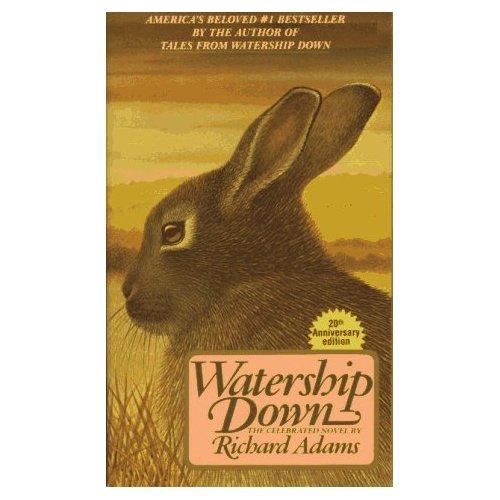
Watership Down
Richard Adams (1972)
“A novel about rabbits that is secretly about every political system humans have ever built — and the stories we tell to survive them.”
This page prints on a single page. Use Ctrl+P / Cmd+P.
Watership Down
Richard Adams (1972) · 476pages · Contemporary · 2 AP appearances
Summary
Fiver, a runt rabbit with prophetic visions, senses the destruction of his home warren. He convinces his brother Hazel to lead a small band of rabbits on a perilous journey across the English countryside to found a new colony on Watership Down. They survive predators, rivers, and hostile warrens — including the totalitarian police state of Efrafa — before establishing a free society built on courage, cooperation, and the storytelling traditions of their trickster hero El-ahrairah.
Why It Matters
Rejected by thirteen publishers, then became one of the best-selling novels in British history. Won both the Carnegie Medal and the Guardian Children's Fiction Prize. Demonstrated that a novel about rabbits could be simultaneously a children's adventure, a political allegory, a work of ecological...
Themes & Motifs
Diction & Style
Register: Formal literary prose grounded in precise ecological observation, with embedded oral-tradition passages for the El-ahrairah myths
Narrator: Third-person omniscient with a naturalist's eye. Adams positions himself as a field observer of rabbit society — auth...
Figurative Language: Moderate
Historical Context
Post-WWII Britain — Cold War, environmental awareness, decolonization: Adams wrote during the Cold War, and the novel's political structure reflects it precisely: Sandleford is the complacent democracy that fails to recognize danger, Cowslip's warren is the consumeris...
Key Characters
Talking Points
- Adams presents three distinct warrens — Sandleford, Cowslip's warren, and Efrafa — each representing a different political system. Identify the political model each warren embodies and explain how Adams uses rabbit behavior to make each system's strengths and failures viscerally felt.
- Fiver's prophetic visions are consistently accurate but consistently ignored by established authority. What is Adams arguing about the relationship between institutional power and prophetic truth? How does this pattern repeat across different warrens?
- The El-ahrairah stories are embedded within the main narrative as tales the rabbits tell each other. Why does Adams include these myths? How do they function differently from simple entertainment — what do they teach, and how do they shape the rabbits' behavior in crisis?
- Compare Hazel's leadership style to Woundwort's. Both are effective leaders who inspire loyalty. What makes their approaches fundamentally different, and what does the novel argue about which model produces a more resilient community?
- Bigwig's declaration — 'My Chief Rabbit has told me to defend this run' — stuns General Woundwort. Why? What does this moment reveal about the limits of Woundwort's understanding, and what does it say about the nature of authority versus leadership?
Notable Quotes
“The field! It's covered with blood!”
“All other determination is gone. There is only one thing left — to go.”
“Rabbits don't swim. But what if a rabbit could float on something that wasn't a rabbit?”
Why Read This
Because this is the most readable political philosophy you will ever encounter. Adams built three complete political systems — the complacent democracy of Sandleford, the decadent surrender of Cowslip's warren, and the totalitarian efficiency of E...