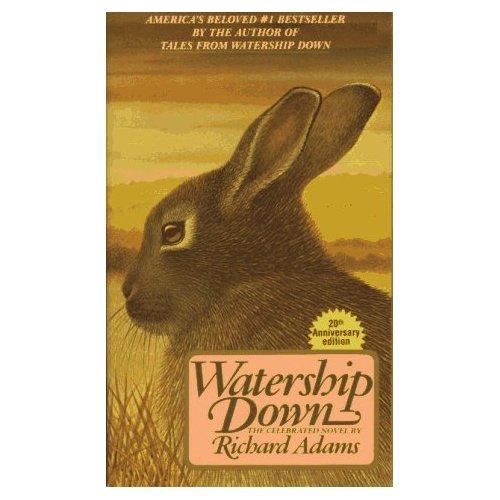
Watership Down
Richard Adams (1972)
“A novel about rabbits that is secretly about every political system humans have ever built — and the stories we tell to survive them.”
Essay Questions & Food for Thought
30questions designed to challenge assumptions and provoke original thinking. These can't be answered from a summary — you need the actual text.
Adams presents three distinct warrens — Sandleford, Cowslip's warren, and Efrafa — each representing a different political system. Identify the political model each warren embodies and explain how Adams uses rabbit behavior to make each system's strengths and failures viscerally felt.
Fiver's prophetic visions are consistently accurate but consistently ignored by established authority. What is Adams arguing about the relationship between institutional power and prophetic truth? How does this pattern repeat across different warrens?
The El-ahrairah stories are embedded within the main narrative as tales the rabbits tell each other. Why does Adams include these myths? How do they function differently from simple entertainment — what do they teach, and how do they shape the rabbits' behavior in crisis?
Compare Hazel's leadership style to Woundwort's. Both are effective leaders who inspire loyalty. What makes their approaches fundamentally different, and what does the novel argue about which model produces a more resilient community?
Bigwig's declaration — 'My Chief Rabbit has told me to defend this run' — stuns General Woundwort. Why? What does this moment reveal about the limits of Woundwort's understanding, and what does it say about the nature of authority versus leadership?
Cowslip's warren has abandoned the traditional El-ahrairah stories in favor of abstract, melancholic poetry. Why does Adams present this cultural shift as a symptom of moral decay? What is the relationship between a society's stories and its capacity for survival?
Adams invented an entire language — Lapine — for his rabbit characters. Analyze the effect of words like 'silflay,' 'elil,' 'hrududu,' and 'tharn' on the reader's experience. Why not simply use English equivalents?
Watership Down is often classified as a children's book. Make the case that it is — and the case that it is not. What elements serve young readers, and what elements are accessible only to readers with political and philosophical experience?
Kehaar the gull speaks in broken pidgin and sees the world from a perspective no rabbit can share. How does Adams use Kehaar to argue for the value of diversity within a community? What does Kehaar provide that the rabbits cannot provide for themselves?
General Woundwort is never confirmed dead — his body is never found, and he passes into rabbit folklore as a bogeyman. Why does Adams deny the reader the satisfaction of seeing the villain destroyed? What does Woundwort's transformation from character to myth accomplish?
Adams based his rabbit behavior on R.M. Lockley's naturalistic study The Private Life of the Rabbit. How does this ecological accuracy affect the novel's allegorical power? Would the political allegory be stronger or weaker if the rabbits behaved less like real rabbits?
The novel has been criticized for its treatment of female characters — the does are largely passive until the Efrafa sequence. Is this a failure of Adams's imagination, a reflection of actual rabbit social structure, or a deliberate choice with thematic implications? Defend your position.
Adams served in the Battle of Arnhem, a military disaster caused by institutional overconfidence and ignored intelligence. How does his wartime experience inform the novel's treatment of leadership, institutional failure, and the cost of ignoring warning signs?
Compare Watership Down to Orwell's Animal Farm. Both use animal societies as political allegory. How do their approaches differ? Which is more effective as political analysis, and which is more effective as literature?
The novel ends with Hazel being invited to join El-ahrairah's Owsla — an invitation that is simultaneously death and transcendence. How does this ending transform the novel's relationship to its own mythology? What happens when a character joins the stories his culture tells?
Blackberry's innovations — the floating board, the boat — represent technological thinking in a species defined by instinct. What is Adams arguing about the relationship between tradition and innovation? Is Blackberry's thinking a departure from rabbit nature or its fulfillment?
The destruction of Sandleford warren — gassed by men building a housing estate — is narrated through Captain Holly's traumatized, fragmentary account. Why does Adams choose this indirect method rather than showing the destruction directly? What is the effect on the reader?
Map the warrens in Watership Down onto contemporary political systems. Which modern societies resemble Sandleford? Cowslip's warren? Efrafa? Watership Down itself? Are any of these mappings exact, or does Adams resist one-to-one allegory?
The novel's epigraphs — drawn from Aeschylus, Shakespeare, Tennyson, Napoleon, and others — frame each chapter in human literary tradition. Why does Adams place a rabbit story inside a framework of human canonical literature? What does this framing accomplish?
Woundwort tells his troops 'Dogs aren't dangerous!' as they flee the dog at Watership Down. Is he wrong? He personally fights the dog and may survive. What does this moment reveal about the gap between individual courage and collective security?
How does Watership Down function as an ecological novel? Adams describes the English countryside with documentary precision — plant species, weather patterns, predator-prey relationships. How does this ecological attention serve the novel's political and philosophical arguments?
The El-ahrairah myth 'The Black Rabbit of Inle' tells of El-ahrairah descending to negotiate with Death itself. How does this story function within the larger novel? What does it teach the rabbits — and the reader — about mortality, sacrifice, and the limits of cunning?
Adams told the story of Watership Down orally to his daughters before writing it as a novel. How does the novel's oral origin manifest in its structure, its pacing, and its relationship to the El-ahrairah stories?
Hyzenthlay is punished in Efrafa for having visions — the same kind of prophetic knowledge that Fiver possesses. What does Adams suggest about how different political systems respond to the same phenomenon? Is prophetic knowledge inherently threatening to authority?
The novel presents a complete hero's journey: departure from the known world, descent into danger, trials, return with the elixir. Map Hazel's journey onto Joseph Campbell's monomyth. Where does the structure align, and where does Adams deviate?
Why does Adams make Watership Down a high, exposed chalk hill rather than a sheltered valley? What are the strategic and symbolic implications of the warren's location?
The rabbits' number system stops at four — anything beyond is 'hrair' (a lot). How does this cognitive limitation affect their perception of danger, their social organization, and their relationship to the human world that surrounds them?
Compare the way Watership Down treats death to the way a typical children's novel treats it. How does Adams's refusal to sanitize death — the snaring, the gassing, the battle wounds — serve the novel's larger arguments about freedom and survival?
The novel was rejected by thirteen publishers. What might have made publishers reluctant to accept a 476-page novel about rabbits? What does its eventual success tell us about the limitations of publishing industry categories?
In the novel's final scene, Hazel leaves his body and joins El-ahrairah. Adams writes: 'It seemed to him that he would not be needing his body any more, so he left it lying on the edge of the ditch.' Analyze the diction of this sentence — its simplicity, its pronoun choices, its refusal of drama. What does Adams achieve by making death this quiet?