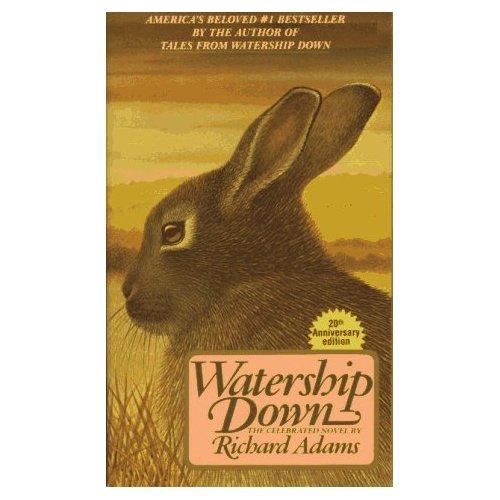
Watership Down
Richard Adams (1972)
“A novel about rabbits that is secretly about every political system humans have ever built — and the stories we tell to survive them.”
Watership Down— Historical Context & Author Background
Author: Richard Adams · Published 1972· Era: Contemporary·476 pages
Themes explored: leadership, home, freedom, nature, storytelling, courage, totalitarianism, community
About Richard Adams
Richard Adams (1920-2016) was a British civil servant who began telling the story of Watership Down to his daughters during long car journeys. He had no literary ambitions — the novel was rejected by thirteen publishers before Rex Collings accepted it in 1972. Adams served in the British Army during WWII, including the Battle of Oosterbeek (Arnhem), and his experience of military organization, leadership under pressure, and the arbitrary violence of war saturates the novel. He studied Modern History at Oxford, giving him the intellectual framework for the political allegory. He worked in the Ministry of Housing and Local Government, where he observed bureaucratic power structures firsthand. The novel made him wealthy and famous at fifty-two, after decades of anonymous civil service.
Life → Text Connections
How Richard Adams's real experiences shaped specific elements of Watership Down.
Adams served in the 1st Airborne Division at Arnhem — a military disaster caused by institutional overconfidence and failure to heed intelligence warnings
The Sandleford warren's refusal to believe Fiver's warning, leading to its destruction
Adams knew from personal experience what happens when institutions ignore prophetic intelligence. The Chief Rabbit's dismissal of Fiver is the warren's version of Operation Market Garden.
Adams worked as a civil servant in the Ministry of Housing, observing bureaucratic power structures for decades
The detailed organizational structures of the warrens — Owsla hierarchies, Mark systems, patrol schedules
Adams understood how institutions function from the inside. Efrafa's bureaucratic totalitarianism is rendered with the specificity of someone who has spent a career watching organizations operate.
The story was invented orally, told to his daughters on car journeys between London and Stratford-upon-Avon
The embedded El-ahrairah stories — tales within the tale, oral performance as communal ritual
The novel's oral origins explain its narrative structure. The El-ahrairah stories are not literary insertions but the original mode of the telling. The novel is itself an El-ahrairah story.
Adams studied the naturalist R.M. Lockley's The Private Life of the Rabbit as research for the novel
The ecologically accurate rabbit behavior — feeding patterns, warren structure, social hierarchies, predator responses
The naturalistic foundation makes the political allegory credible. Because the rabbits behave like real rabbits, their political systems feel like real political systems.
Historical Era
Post-WWII Britain — Cold War, environmental awareness, decolonization
How the Era Shapes the Book
Adams wrote during the Cold War, and the novel's political structure reflects it precisely: Sandleford is the complacent democracy that fails to recognize danger, Cowslip's warren is the consumerist society that trades freedom for comfort, and Efrafa is the totalitarian state that provides security at the cost of liberty. Watership Down itself is the novel's answer — a society that combines freedom with responsibility, individual initiative with communal loyalty. The environmental consciousness of the 1970s gives the novel its ecological depth: Adams treats the English countryside not as backdrop but as a living system that the rabbits must understand to survive.
Why Watership Down Matters Historically
Rejected by thirteen publishers, then became one of the best-selling novels in British history. Won both the Carnegie Medal and the Guardian Children's Fiction Prize. Demonstrated that a novel about rabbits could be simultaneously a children's adventure, a political allegory, a work of ecological philosophy, and a meditation on myth and storytelling. It proved that genre boundaries — children's vs. adult, fantasy vs. realism, adventure vs. literature — were artificial constraints that a sufficiently ambitious novel could simply ignore.
- One of the first novels to construct a complete animal language (Lapine) with consistent grammar and vocabulary
- Pioneered the use of ecologically accurate animal behavior as the basis for political allegory
- One of the first 'crossover' novels — marketed to children but read primarily by adults, anticipating the Harry Potter phenomenon
- Demonstrated that embedded mythological narratives (the El-ahrairah stories) could function as political philosophy within a realist framework
Challenged in some American schools for violence (the snaring of Bigwig, the gassing of Sandleford, the battle sequences) and for its depiction of death. Also criticized for its limited female characters — the does are largely passive until the later chapters. Adams acknowledged this as a weakness of the original conception.