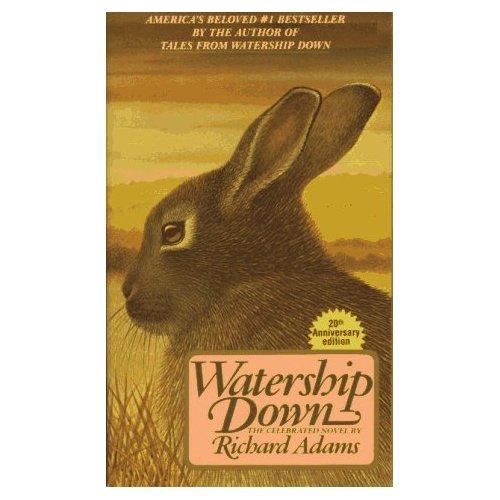
Watership Down
Richard Adams (1972)
“A novel about rabbits that is secretly about every political system humans have ever built — and the stories we tell to survive them.”
Language Register
Formal literary prose grounded in precise ecological observation, with embedded oral-tradition passages for the El-ahrairah myths
Syntax Profile
Adams writes in long, precisely constructed sentences for the naturalistic passages, with careful subordination and a steady accumulation of sensory detail. The El-ahrairah stories shift to a shorter, more rhythmic syntax — the cadences of oral performance. Dialogue is naturalistic and varied: Hazel speaks in short, practical sentences; Bigwig is blunt and imperative; Fiver is fragmentary and visionary; Kehaar's pidgin is syntactically broken but semantically sharp.
Figurative Language
Moderate — Adams relies more on precise literal description than on metaphor. When figurative language appears, it tends toward the ecological: landscapes as emotional states, weather as political atmosphere, the relationship between predator and prey as the fundamental metaphor for power.
Era-Specific Language
Feeding above ground — the most dangerous and most necessary activity in rabbit life
Motor vehicle — rendered as incomprehensible noise, reflecting the rabbit's perception of human technology
Predators — a collective noun that collapses all threats into a single category of existential danger
The warren's ruling council/military elite — Adams's word for the officer class in any political system
Paralyzed by fear — the rabbit equivalent of shellshock, a state where terror overrides all function
The sun god — the deity of rabbit theology, creator and ultimate authority
How Characters Speak — Class & Identity
Hazel
Practical, concise, consultative. Asks questions more than he gives orders. Uses inclusive language — 'we' rather than 'I.'
Democratic leadership expressed through speech: authority earned by listening, not commanding.
Bigwig
Blunt, imperative, physically expressive. Short sentences. Commands rather than requests.
The warrior's idiom: direct, unambiguous, calibrated for crisis. Bigwig speaks the way he fights.
Fiver
Fragmentary, visionary, often incoherent. His language breaks down under the pressure of prophetic vision.
The prophet's speech: truth that exceeds the capacity of ordinary language. Fiver's incoherence is the marker of authentic vision.
General Woundwort
Absolute, declarative, brooking no dissent. Every sentence is a command or a verdict.
Totalitarian speech: language as instrument of control. Woundwort does not converse — he pronounces.
Kehaar
Broken pidgin English with phonetic spelling — 'Ees peeg,' 'Ya ya, I show you.' Syntactically fractured but semantically precise.
The immigrant's voice: outsider perspective rendered through linguistic alienation. Kehaar sees what the rabbits cannot because he is not one of them.
Narrator's Voice
Third-person omniscient with a naturalist's eye. Adams positions himself as a field observer of rabbit society — authoritative, sympathetic, never sentimental. The narrator has access to rabbit psychology but renders it through behavior and dialogue rather than interior monologue. The effect is of a documentary filmmaker who happens to speak Lapine.
Tone Progression
Chapters 1-10
Urgent, ecological, precise
The journey chapters establish the physical world with documentary authority. Fear is constant but the prose is controlled.
Chapters 11-22
Philosophical, mythological, settling
Cowslip's warren and the new colony introduce the novel's political and cultural arguments. The El-ahrairah stories create a second register.
Chapters 23-39
Tense, claustrophobic, strategic
The Efrafa sequence darkens the prose. Surveillance and control compress the language. The escape chapters explode into kinetic action.
Chapters 40-50
Epic, elegiac, transcendent
The siege achieves epic intensity. The aftermath settles into autumnal peace. The final chapters achieve a luminous simplicity that transcends genre.
Stylistic Comparisons
- Tolkien — world-building through language, but Adams's ecology is real where Tolkien's is invented
- Orwell's Animal Farm — political allegory through animals, but Adams is warmer, more complex, and less schematic
- Kenneth Grahame's The Wind in the Willows — English pastoral with animal protagonists, but Adams replaces whimsy with naturalism and political seriousness
- Homer's Odyssey — the journey home as foundational narrative structure, complete with embedded stories and divine intervention
Key Vocabulary from This Book
Notable words used in this text — click to see full definitions