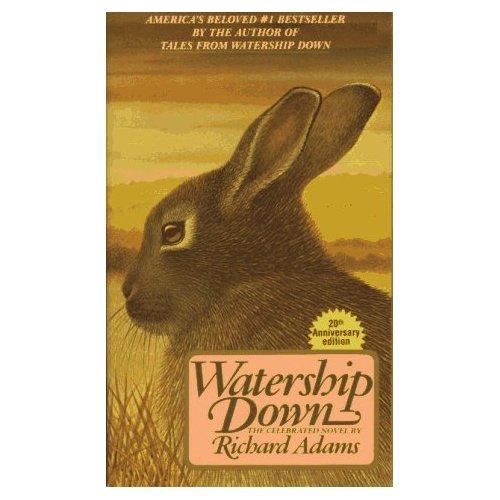
Watership Down
Richard Adams (1972)
“A novel about rabbits that is secretly about every political system humans have ever built — and the stories we tell to survive them.”
For Students
Because this is the most readable political philosophy you will ever encounter. Adams built three complete political systems — the complacent democracy of Sandleford, the decadent surrender of Cowslip's warren, and the totalitarian efficiency of Efrafa — and let you experience them from the inside, through characters you care about. The El-ahrairah stories teach you how myth functions in a living culture. The lapine language teaches you how vocabulary shapes perception. And the adventure is genuinely thrilling. This is a novel that makes you think like a rabbit, and in doing so, makes you think more clearly about what it means to be human.
For Teachers
A rare novel that works at every level of instruction. Middle school students engage with the adventure and the animal characters. High school students discover the political allegory and the mythological structure. AP students can analyze the embedded narratives, the constructed language, the ecological philosophy, and the hero's journey structure. The novel supports units on political science, environmental studies, mythology, and narrative theory simultaneously. Its length is an asset, not an obstacle — there is enough material for a full semester.
Why It Still Matters
Every warren in Watership Down has a modern equivalent. Sandleford is any institution too complacent to respond to existential warnings — climate change denial, pandemic unpreparedness, financial deregulation. Cowslip's warren is the comfortable society that accepts surveillance and algorithmic control in exchange for convenience. Efrafa is every authoritarian system that promises security in exchange for freedom. And Watership Down itself is the argument that free societies, for all their apparent messiness, possess a resilience that controlled societies cannot match. The novel was written in 1972 and has not aged at all.