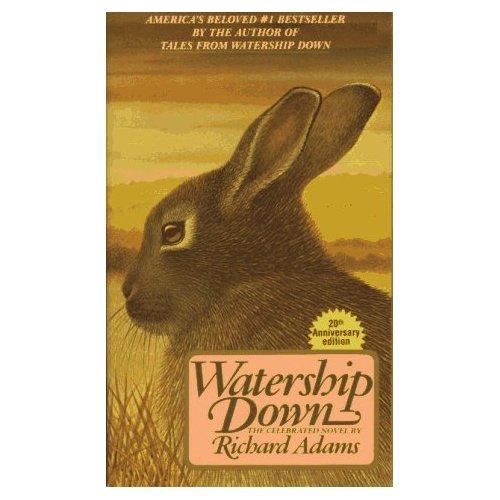
Watership Down
Richard Adams (1972)
“A novel about rabbits that is secretly about every political system humans have ever built — and the stories we tell to survive them.”
Why This Book Matters
Rejected by thirteen publishers, then became one of the best-selling novels in British history. Won both the Carnegie Medal and the Guardian Children's Fiction Prize. Demonstrated that a novel about rabbits could be simultaneously a children's adventure, a political allegory, a work of ecological philosophy, and a meditation on myth and storytelling. It proved that genre boundaries — children's vs. adult, fantasy vs. realism, adventure vs. literature — were artificial constraints that a sufficiently ambitious novel could simply ignore.
Firsts & Innovations
One of the first novels to construct a complete animal language (Lapine) with consistent grammar and vocabulary
Pioneered the use of ecologically accurate animal behavior as the basis for political allegory
One of the first 'crossover' novels — marketed to children but read primarily by adults, anticipating the Harry Potter phenomenon
Demonstrated that embedded mythological narratives (the El-ahrairah stories) could function as political philosophy within a realist framework
Cultural Impact
The 1978 animated film introduced the novel to a generation of children who were traumatized and transformed by its violence and beauty
Influenced every subsequent work of animal fantasy, from Redwall to Warriors to The Animals of Farthing Wood
'Going tharn' entered informal English as a description of fear-paralysis
The novel became a touchstone for environmental movements — Adams's ecological vision resonated with conservationist arguments
BBC/Netflix adaptation (2018) reintroduced the novel to contemporary audiences
The El-ahrairah stories inspired academic study of embedded narrative and the role of myth in political organization
Banned & Challenged
Challenged in some American schools for violence (the snaring of Bigwig, the gassing of Sandleford, the battle sequences) and for its depiction of death. Also criticized for its limited female characters — the does are largely passive until the later chapters. Adams acknowledged this as a weakness of the original conception.