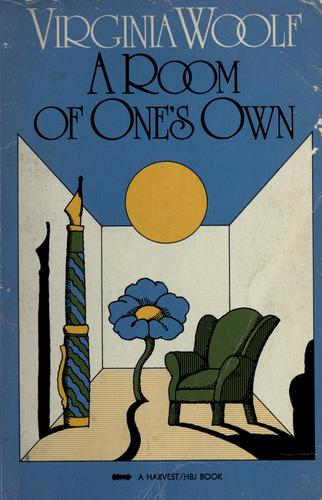
A Room of One's Own
Virginia Woolf (1929)
“A woman needs money and a room of her own to write fiction — but the sentence is only the beginning. Behind it lies four centuries of locked doors, burned manuscripts, invented sisters, and the long material history of why genius requires a bank account.”
A Room of One's Own— Historical Context & Author Background
Author: Virginia Woolf · Published 1929· Era: Modernist·172 pages
Themes explored: gender, freedom, art, class, silence, power, identity
About Virginia Woolf
Virginia Woolf (1882-1941) delivered the two lectures that became A Room of One's Own at Newnham and Girton Colleges, Cambridge, in October 1928. She was forty-six, already the author of Mrs. Dalloway (1925) and To the Lighthouse (1927), and at the height of her intellectual powers. She had been denied the Cambridge education her brothers received — a fact the essay addresses directly. She had inherited money from her aunt Caroline Emelia Stephen, which gave her the financial independence she argues is essential to creative work. She and Leonard Woolf ran the Hogarth Press, which published the essay in 1929, giving her complete control over its production and distribution. She was in the midst of her relationship with Vita Sackville-West, which informed the essay's coded discussions of women's desire for each other. The essay was written in the same period as Orlando (1928), her fictional biography of Sackville-West, which also explored gender fluidity and androgyny. Woolf had managed recurring mental illness throughout her adult life and would die by suicide in 1941, walking into the River Ouse with stones in her pockets.
Life → Text Connections
How Virginia Woolf's real experiences shaped specific elements of A Room of One's Own.
Woolf was denied the Cambridge education her brothers Thoby and Adrian received — they attended Trinity College while she was educated at home by her father and through the Ladies' Department of King's College London
The opening chapter's Oxbridge scenes — being waved off the grass, refused entry to the library — are not abstract fictions but precise renderings of the exclusion Woolf experienced
The essay's anger is personal before it is political. Woolf knew exactly what the locked library door felt like because she had stood outside it.
Woolf inherited approximately 2,500 pounds from her aunt Caroline Emelia Stephen in 1909, which provided the annual income of roughly 500 pounds she specifies in the essay
The five hundred pounds a year is not a rhetorical invention — it is Woolf's actual inheritance, and she credits it with making her writing career possible
The material argument is autobiographical. Woolf did not theorize financial independence in the abstract — she lived the difference between dependence and freedom, and the essay describes that difference from experience.
Woolf's relationship with Vita Sackville-West was at its most intense in 1927-1928, the period of the lectures' composition
The 'Chloe liked Olivia' passage in Chapter Five — with its elaborate precautions about privacy and its coded reference to women's desire — reflects Woolf's own experience of love between women in a society that had just prosecuted Radclyffe Hall's The Well of Loneliness for obscenity
The essay's argument about what can and cannot be said in women's writing was shaped by what Woolf herself could and could not say about her most important relationship.
The Hogarth Press, which Woolf and Leonard founded in 1917, gave Woolf complete control over the publication of her own work — no male editor could alter, censor, or reject what she wrote
The essay's argument about the material conditions of writing includes, implicitly, the conditions of publication. Woolf had her own press — most women writers did not.
Woolf practiced what she preached. The essay argues that women need control over the means of production. Woolf had that control, and the essay exists in its uncompromised form because of it.
Woolf's mental illness — recurring breakdowns, two suicide attempts, periods when she was unable to write — was treated by doctors who prescribed rest cures and prohibited intellectual work
The essay's distrust of institutional authority — the Beadle, the British Museum's male scholars, the system that silences women's voices — echoes Woolf's experience of doctors who silenced her
The essay's argument about who gets to define the boundaries of acceptable thought was shaped by Woolf's experience of having her own thinking declared dangerous by medical authorities.
Historical Era
Interwar Britain, 1928-1929 — women's suffrage newly achieved, the aftermath of the Radclyffe Hall obscenity trial, the brief cultural opening between the trauma of WWI and the gathering storm of the 1930s
How the Era Shapes the Book
The essay was delivered at the exact historical moment when women's legal equality was being formally established (full suffrage in 1928) but material equality remained distant. Woolf's argument is that legal rights alone are insufficient — without money, space, education, and tradition, formal equality produces only the appearance of freedom. The essay is haunted by the gap between what women had just been granted in law and what they still lacked in fact. It is also shaped by the Radclyffe Hall trial, which demonstrated that women's freedom to write about their own experience — particularly sexual experience — remained subject to male judicial authority.
Why A Room of One's Own Matters Historically
A Room of One's Own is the founding text of modern feminist literary criticism — the work that first systematically connected the material conditions of women's lives to the literature they could and could not produce. Its central arguments — that creative freedom requires economic independence, that literary tradition is shaped by power rather than merit, that the absence of women from the canon reflects social exclusion rather than natural inferiority — have become the foundational assumptions of feminist scholarship across disciplines.
- The first sustained argument that women's literary production is determined by material conditions — money, space, education — rather than talent or nature
- The first major work of feminist literary criticism, predating Simone de Beauvoir's The Second Sex by twenty years
- Introduced the thought experiment of Judith Shakespeare, which became the most widely cited illustration in feminist theory of how structural inequality destroys individual potential
- First prominent articulation of the theory of the androgynous mind as the ideal creative consciousness
- One of the earliest works to argue that literary forms themselves — the sentence, the novel, the essay — carry gendered assumptions that women writers must confront and transform
Not formally banned but consistently contentious. The essay has been challenged in educational settings for its feminist politics, its implicit (and occasionally explicit) discussion of same-sex desire, and its critique of patriarchal authority. In the 1930s and 1940s, male critics dismissed it as 'shrill' and 'unbalanced.' Q.D. Leavis called it 'dangerous feminist propaganda.' In more recent decades, it has been challenged from within feminism for its class blindness — Woolf's five hundred pounds a year was available to very few women — and its racial exclusions. The essay assumes a white, English, upper-middle-class woman as its default subject.