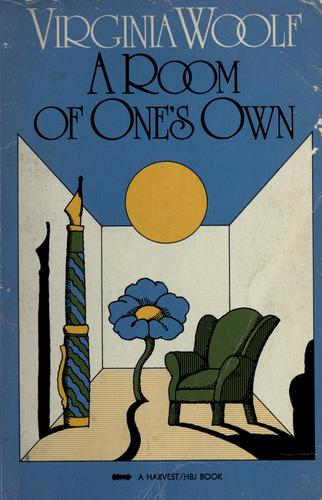
A Room of One's Own
Virginia Woolf (1929)
“A woman needs money and a room of her own to write fiction — but the sentence is only the beginning. Behind it lies four centuries of locked doors, burned manuscripts, invented sisters, and the long material history of why genius requires a bank account.”
Why This Book Matters
A Room of One's Own is the founding text of modern feminist literary criticism — the work that first systematically connected the material conditions of women's lives to the literature they could and could not produce. Its central arguments — that creative freedom requires economic independence, that literary tradition is shaped by power rather than merit, that the absence of women from the canon reflects social exclusion rather than natural inferiority — have become the foundational assumptions of feminist scholarship across disciplines.
Firsts & Innovations
The first sustained argument that women's literary production is determined by material conditions — money, space, education — rather than talent or nature
The first major work of feminist literary criticism, predating Simone de Beauvoir's The Second Sex by twenty years
Introduced the thought experiment of Judith Shakespeare, which became the most widely cited illustration in feminist theory of how structural inequality destroys individual potential
First prominent articulation of the theory of the androgynous mind as the ideal creative consciousness
One of the earliest works to argue that literary forms themselves — the sentence, the novel, the essay — carry gendered assumptions that women writers must confront and transform
Cultural Impact
Became the touchstone text for second-wave feminism in the 1960s and 1970s — Kate Millett, Germaine Greer, and Elaine Showalter all wrote in direct response to it
The phrase 'a room of one's own' entered common language as shorthand for the material conditions necessary for creative or intellectual independence
Simone de Beauvoir's The Second Sex (1949) extended Woolf's material analysis into a comprehensive existentialist account of women's oppression
Elaine Showalter's A Literature of Their Own (1977) challenged Woolf's androgyny thesis while building on her literary-historical method, generating one of the most productive debates in feminist criticism
Sandra Gilbert and Susan Gubar's The Madwoman in the Attic (1979) applied Woolf's method — connecting women's material conditions to their literary production — to the entire nineteenth-century English novel
The essay's influence extends beyond literature into economics (the argument that intellectual production requires material support), architecture (the argument that women's creativity requires physical space), and education (the argument that institutional exclusion shapes what can be thought)
Banned & Challenged
Not formally banned but consistently contentious. The essay has been challenged in educational settings for its feminist politics, its implicit (and occasionally explicit) discussion of same-sex desire, and its critique of patriarchal authority. In the 1930s and 1940s, male critics dismissed it as 'shrill' and 'unbalanced.' Q.D. Leavis called it 'dangerous feminist propaganda.' In more recent decades, it has been challenged from within feminism for its class blindness — Woolf's five hundred pounds a year was available to very few women — and its racial exclusions. The essay assumes a white, English, upper-middle-class woman as its default subject.