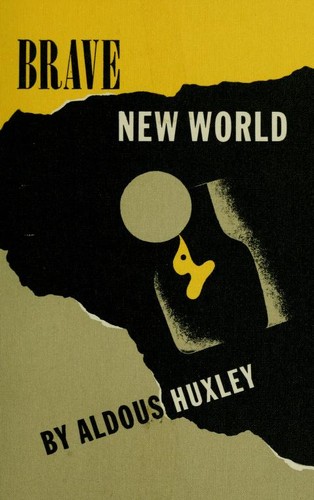
Brave New World
Aldous Huxley (1932)
“A world where everyone is happy, no one suffers, and something irreplaceable has been destroyed.”
This page prints on a single page. Use Ctrl+P / Cmd+P.
Brave New World
Aldous Huxley (1932) · 311pages · Modernist / Dystopian · 9 AP appearances
Summary
In the World State of 632 A.F. (After Ford), human beings are manufactured in hatcheries, conditioned from birth, and kept pacified with the pleasure drug soma. Bernard Marx, an Alpha intellectual who feels like an outsider, takes the pneumatic Lenina Crowne to a Savage Reservation in New Mexico, where they discover John — the son of a World State woman, raised on Shakespeare. John is brought back to civilization as a curiosity, but he's horrified by its shallow hedonism. When he rebels, demanding the right to be unhappy, the World Controller Mustapha Mond explains why the choice was made: stability required the sacrifice of art, science, religion, and authentic emotion. John retreats to a lighthouse to live as an ascetic and is eventually destroyed by the world's voyeuristic hunger for his suffering.
Why It Matters
Published in 1932, it was immediately recognized as a significant work but did not achieve its current canonical status until after Nineteen Eighty-Four (1949) made dystopian fiction culturally central. The comparison with Orwell clarified what Huxley was doing: where Orwell feared totalitarianis...
Themes & Motifs
Diction & Style
Register: Formal-scientific in World State sections; archaic Shakespearean for John; journalistic irony throughout
Narrator: Huxley narrates in omniscient third-person with a sardonic, essayistic intelligence — less character-bound than Fitzg...
Figurative Language: High in satirical passages; deliberately flat in administrative/conditioning descriptions. The horror of World State language is its absence of figurative language
Historical Context
Interwar Britain — 1920s-1930s, industrial modernity, mass culture, early totalitarianism: Huxley was writing in 1931, watching Soviet collectivism and German nationalism simultaneously, and reading utopian social scientists who believed human nature could be reshaped by the right instit...
Key Characters
Talking Points
- Huxley's World State uses pleasure, not pain, as its primary tool of control. Why is this more effective — and more disturbing — than Orwell's pain-based dystopia in Nineteen Eighty-Four?
- Mustapha Mond argues that stability and truth are incompatible. Is he right? Give three examples from inside and outside the novel where pursuing absolute stability required abandoning truth.
- John claims 'the right to be unhappy.' Is this a reasonable demand? Is unhappiness a right — or just the price of other things that are rights?
- Bernard Marx is the novel's point-of-view character for most of the first half, but he is also consistently unsympathetic. Why does Huxley make his rebel so petty? What does this say about the nature of dissent within the World State?
- John's entire emotional vocabulary comes from Shakespeare. What happens when you only have one book to interpret your entire experience? How does Shakespeare both help and trap John?
Notable Quotes
“Bokanovsky's Process is one of the major instruments of social stability.”
“Community, Identity, Stability.”
“Till at last the child's mind is these suggestions, and the sum of the suggestions is the child's mind.”
Why Read This
Because Huxley predicted Instagram, SSRIs, Netflix, and genetic engineering in 1932 — and explained the philosophical problem with all of them simultaneously. The World State is not obviously evil. That's the entire point. Everything it does makes...