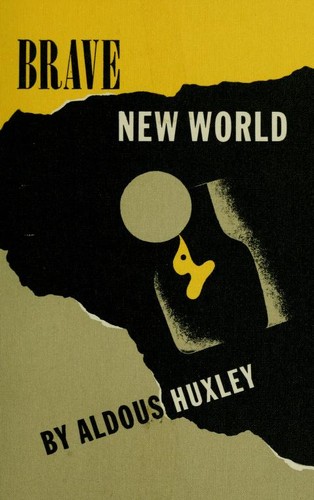
Brave New World
Aldous Huxley (1932)
“A world where everyone is happy, no one suffers, and something irreplaceable has been destroyed.”
Why This Book Matters
Published in 1932, it was immediately recognized as a significant work but did not achieve its current canonical status until after Nineteen Eighty-Four (1949) made dystopian fiction culturally central. The comparison with Orwell clarified what Huxley was doing: where Orwell feared totalitarianism through pain, Huxley feared it through pleasure. The two novels are now read together as complementary warnings — and many critics argue the twenty-first century has proved Huxley more prescient.
Firsts & Innovations
First major dystopian novel to locate the horror in happiness rather than suffering — the 'soft' dystopia that uses pleasure as control
First literary treatment of genetic engineering as social policy — Huxley anticipated CRISPR and designer embryos by six decades
First sustained literary argument that the demand for stability and the demand for meaning are fundamentally incompatible
Cultural Impact
Soma entered common language as a metaphor for any pleasure used to prevent political engagement
The Bokanovsky Process anticipated and shaped public debate about cloning ethics decades before the technology existed
Neil Postman's Amusing Ourselves to Death (1985) explicitly uses the Huxley/Orwell contrast as its thesis: Orwell feared book-banners; Huxley feared there'd be no reason to ban books because no one would want to read them
Taught alongside Nineteen Eighty-Four in virtually every AP English and college course covering dystopian literature
The phrase 'brave new world' (taken from Shakespeare's The Tempest) has become standard English idiom for any radically unfamiliar and disturbing new situation
Banned & Challenged
Banned and challenged extensively. Ireland banned it in 1932 on publication; India banned it in 1967 for its sexual content. Regularly challenged in American schools for 'insensitivity,' 'offensive language,' 'sexual content,' and — most revealingly — 'making promiscuous sex appear attractive and moral.' The challenges typically miss that the novel is satirizing the society they're defending.